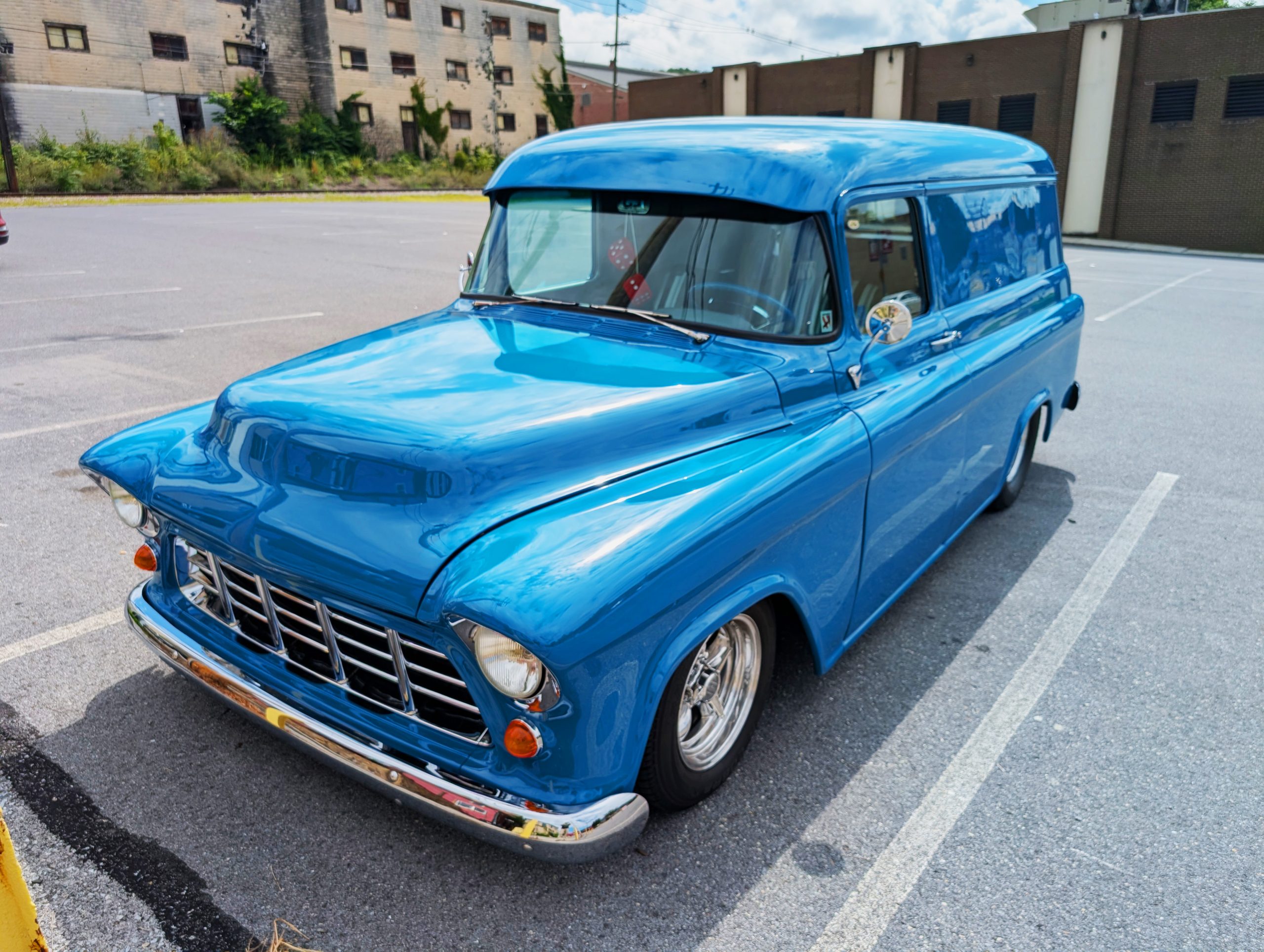
1956 Chevrolet 3100 panel
The truck is parked nose-out in front of the Windber post office, which is roughly where a truck like this would have parked seventy years ago, except then it would have been backed up to a loading door and someone would have been swearing at it.
It’s a 1956 Chevrolet 3100 panel. Half-ton, Task Force generation, second year of the body. The wraparound windshield and the hooded headlight pods put it in the ’55–’57 window, and the grille bars and hood treatment land it on ’56 specifically. That was the model year Chevrolet had finally let the truck division borrow from the car division — twelve-volt electrical, optional 265 small block, a cab that didn’t punish you for driving it all day.
There’s a green registration card taped inside the windshield, number 548, and a current Pennsylvania sticker beside it. Fuzzy dice on the mirror stem. Somebody drove this here.
What the shape was for
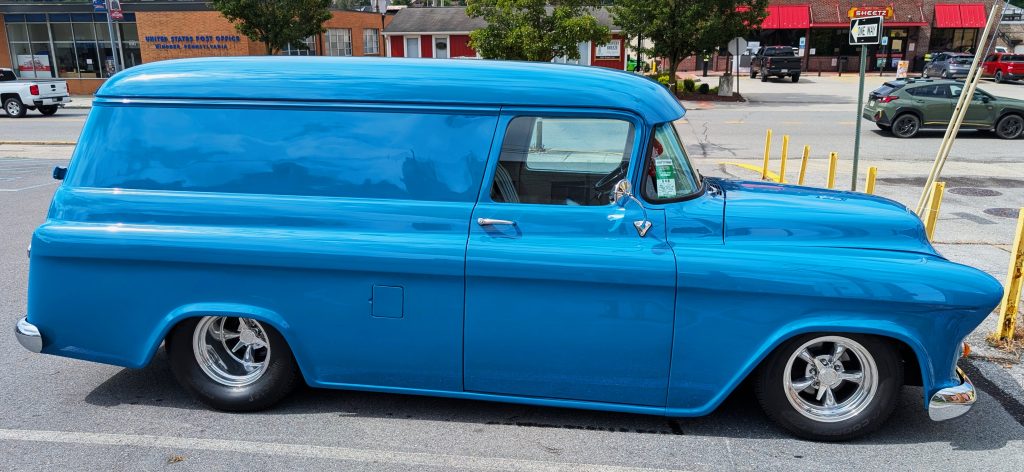
A panel truck is a pickup that gave up its bed and grew a roof. Same frame, same cowl, same doors, same everything forward of the B-pillar. Behind that, sheet metal floor to roofline, both sides solid.
The solid sides were the entire point. They were advertising.
Every panel truck left the factory as a blank sign, and the first thing a buyer did was hand it to a lettering man with a quill brush and a maulstick. Bakery routes. Laundry pickup. Plumbing. Electrical. Fuel oil. A florist. A doctor’s supply house. The sides carried a business name, a phone exchange with letters in it, a street address, and if the owner felt expansive, a painted illustration of the product. The truck was the billboard, and unlike a billboard it drove past the customer’s house twice a week.
Read the shape and you can read the requirements. Roof high enough to stand hunched. Rear opening wide enough for a bread rack. Load floor low, because the driver makes forty stops a day and each one costs him a lift. One curbside door, so he steps out onto sidewalk instead of into traffic. Ford, Dodge, GMC, International, Studebaker — everybody built the same object, because everybody was solving the same problem.
Why the shape died
It lost on the one number that mattered.
Engine out front, in a hood, ahead of the driver. That’s four feet of vehicle length spent on machinery instead of cargo. In 1956, that was just how a truck was built. In 1961 Ford put the Econoline’s engine between and behind the front seats and moved the whole van forward over the front wheels. Chevrolet answered with the Corvair-based Greenbrier, then with the Chevy Van in 1964. Same footprint at the curb, dramatically more box.
Route operators run spreadsheets whether or not they call them that, and cubic feet per parking space is a number. The cab-forward van won it decisively. The panel body was out of Chevrolet’s catalog by 1966, and out of the culture within a decade after that. It has no modern descendant. The Transits and Sprinters and ProMasters are its grandchildren, and none of them look anything like it.
What happened to this one
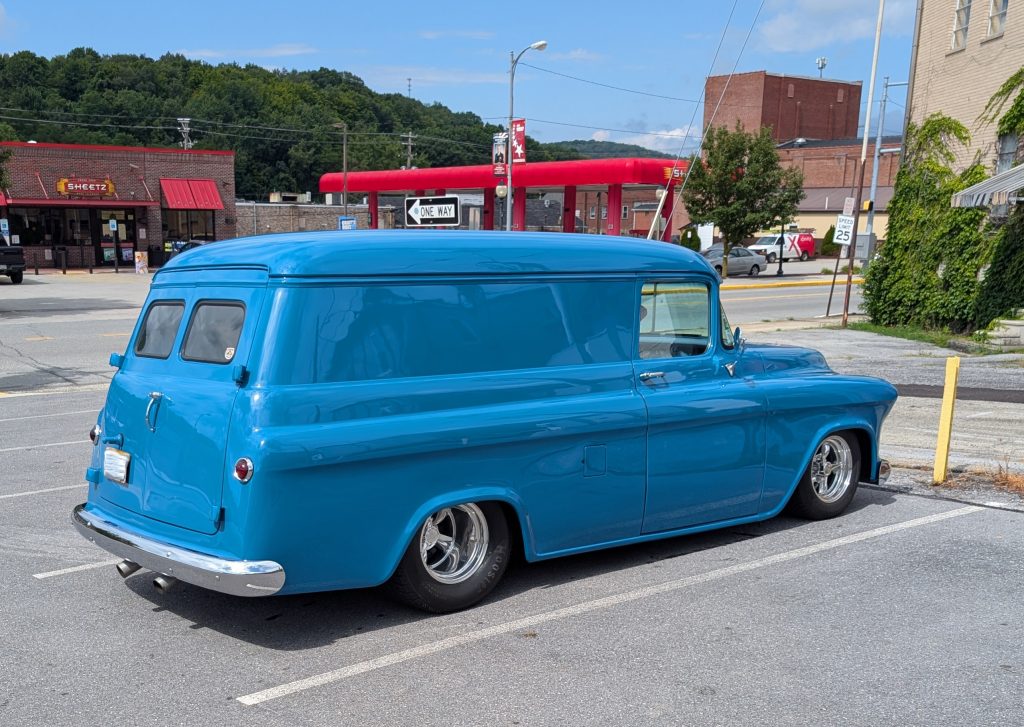
It’s been rodded, and there’s no point pretending otherwise.
The stance is on the ground. Front wheel arch sitting close enough to the tire that this is dropped spindles at minimum and probably a swapped front clip. Polished five-spokes at all four corners. Cooper rubber up front, Hoosiers out back — a drag tire, which tells you something about intent. Dual exhaust exiting under the rear bumper through two tips making no attempt at subtlety. Side trim deleted, body smoothed, and one uninterrupted coat of a blue sitting somewhere between factory Robin’s Egg and a shade the painter mixed himself.
Chrome bullet mirror on the driver’s door. White interior. The rear doors have been glazed, so daylight reaches the cargo hold — something no bakery ever asked for and every builder does.
And here’s the part worth sitting with: the sides are still blank.
The one surface the truck was designed around, the flat expanse that justified the body style existing, and it carries nothing. No name, no trade, no phone number. It is the most expensive blank canvas in the parking lot, and the blankness is the statement. A lettered panel truck is a business expense. An unlettered one is a hobby. The vehicle lost its purpose and was handed a different one.
Why it’s still here
Because it can be fixed.
Body-on-frame. Bolted fenders. A separate front clip. Sheet metal thick enough to work with a hammer and dolly instead of replacing as an assembly. An engine bay with room to put a knee in. Every wear part on the thing is still manufactured, reproduced by three aftermarket suppliers, or fabricable in any shop with a lathe.
Seventy years is a long service life for anything with wheels. It happened because the truck was built to be maintained by whoever bought it, on the assumption that whoever bought it needed it running Monday morning.
That assumption has been retired. Current vehicles are assembled to be replaced — modules swapped rather than repaired, and software gating the swap. We’ll find out in 2096 how many of them are parked in front of a post office.
Windber, appropriately
Worth noting where it’s sitting. Windber is a laid-out town. Berwind-White Coal Mining Company platted it in the 1890s, numbered the streets, built the housing, and named the place after itself with the syllables reversed. A company town is a designed object in the same sense a panel truck is a designed object: somebody drew it, somebody built it to a specification, and the specification came from a business requirement.
Both outlived the requirement. The coal company is gone and the town is still here. The bread routes are gone and the truck is still here — blue, blank on both sides, sitting between a Sheetz and a post office on a street posted for twenty-five.
Made things outlast the reasons they were made for. That’s most of what this column is about.