I want to be honest with you about how this one started, because if I dress it up as research you’ll know I’m lying.
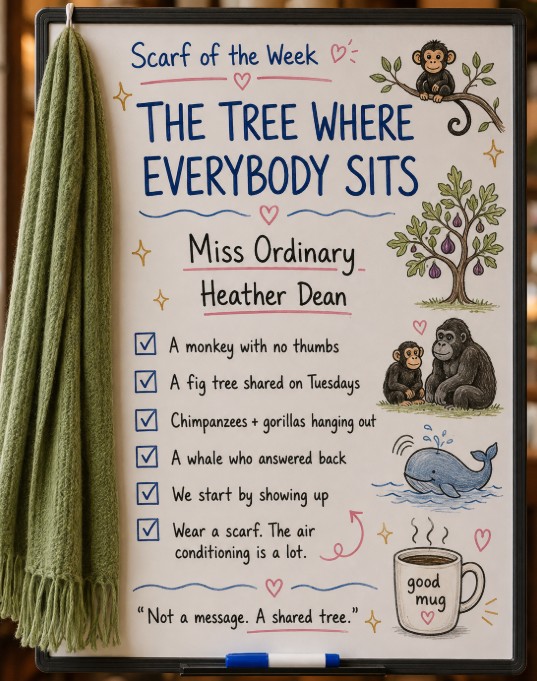
I was at the coffee shop on a Tuesday, in the chair by the window, with my laptop open to a document I had opened four days earlier and added one sentence to. The mug was the good mug — they only have two of that shape and I have developed a small unspoken competition with a man in a fleece vest over which of us gets it. I had my green scarf on, the thin one, because it was August and the air conditioning in there is set for a walk-in cooler.
I was not working. I want that on the record. I was doing the thing where you scroll to the bottom of a document and look at it with a serious expression.
And two tables over, a guy had a video going on his laptop, turned just enough that I could see it and not hear a word of it. Two men talking. Podcast setup, the big microphones, that particular lighting. One of them I recognized — the animal one, the conservation biologist who goes and finds species everyone thinks are gone. He does that thing with his hands when he’s excited about something, where he stops using them for gesturing and starts using them for demonstrating. I have watched a nonzero amount of his stuff. I find him very informative.
Anyway.
The screen behind them cut to a monkey. Then to trees. Then to a map of Africa with a little wedge highlighted. And then, briefly, to a word I could read from two tables away: thumbless.
I would like to tell you I went back to my document.
The Monkey With No Thumbs
Here is what I found on my phone in the next forty minutes, which I am now presenting as though it were a plan.
There is a new monkey. Actually new — only the fifth new species of African monkey described in the past seventy-five years. It lives high in the canopy in a park in the Democratic Republic of Congo, it is small and black with pale orange around its mouth like it got into something, and the people who live in its range call it Likweli, which the scientists recommended keeping as the common name. That detail got me. Somebody could have named it after themselves and instead they kept the name it already had.
And it has no thumbs.
Not “small thumbs.” The whole family it belongs to is named for this — Colobus comes from a Greek word meaning docked or cut short. Somebody looked at these animals a long time ago and named them after the thing they were missing.
Except they aren’t missing anything. They gave it up. A hand without a thumb slides over branches like a hook instead of catching on them, and if your whole life happens ninety feet in the air, a hook beats a grip. They traded the thumb for speed. Spider monkeys in South America made the same trade separately, on a different continent, for the same reason.
I sat there with my hand around my mug thinking about how much I like my thumbs. I use them for everything. I have built an entire life on the assumption that thumbs are the good part.
And here’s this animal doing perfectly well, up in a tree, having decided the good part was somewhere else.
The Part That Actually Got Me
That was the fun fact. This is the other thing.
The same forest keeps coming up in this research — a wedge of ground between two rivers called the Goualougo Triangle. It’s the only place on Earth where both chimpanzees and gorillas have gotten used to people watching them. Which takes about a decade, by the way. A decade of somebody walking behind an animal every single day until the animal decides you’re furniture.
And because those researchers put in that decade, they were standing right there for something nobody had ever been positioned to see.
Chimpanzees and gorillas are hanging out.
Not passing each other. Not sharing a forest the way I share a coffee shop with the fleece vest man. These are relationships between specific individuals, held over years, across different situations. Particular chimps and particular gorillas who know each other. The young ones play together. Mothers with babies — the ones with everything to lose — will sit near a gorilla and let it be fine.
And do you know how it started?
Fruit.
They keep ending up in the same fig trees. That’s it. That’s the whole origin. Two kinds of animal that split apart about nine million years ago, that don’t speak the same way or move the same way or live the same way, kept showing up at the same tree because the tree had food in it, and after enough Tuesdays they stopped being strangers. CONGO-APES
I sat with that for a while. My coffee got to the temperature where you have to decide whether you’re committed.
We Don’t Know How Ours Started
Here’s why I couldn’t put it down.
There’s a fossil site in South Africa where at least three different kinds of early human were living in an area about the size of that forest in Congo, two million years ago. Different species. Same neighborhood. And with all our science, we cannot tell whether any of them ever actually saw each other. Bones can tell you who was there. They can’t tell you who met.
And then much later — much closer to us — humans and Neanderthals overlapped in Europe and the Middle East, and we know for absolute certain that they didn’t just overlap, because most people walking around today are carrying a percent or two of Neanderthal DNA in their bodies right now. There’s a man they found in a cave in Romania who had a Neanderthal great-great-grandparent. Four generations back. That’s about the distance between me and the aunt who gave me my first scarf, if you tip it a couple more.
So we know it happened. We have the receipts, literally in our cells.
We have no idea how it started. Not the first meeting. Not who spoke first, or whether anybody spoke, or whether it was frightening or gradual or ordinary. Every version of that story anyone has ever told you is somebody guessing.
And in a forest in the Congo, right now, on a Tuesday, two kinds of ape who are not us are doing that exact thing where we can watch. Starting from nothing. Working it out.
Because of a fig tree.
The Whale, Briefly, Because I Can’t Not
One more and then I’ll let you go.
In Alaska, some scientists played a recorded humpback greeting into the water through a speaker. A thirty-eight-year-old female they call Twain came over, circled the boat, and answered — for twenty minutes, matching the timing of every call they sent. nih
The team doing it works with the people who search for signals from space. They’re practicing. They wanted to know whether something completely unlike us would bother to answer at all, and a whale in Alaska said yes.
I love that the answer to one of the largest questions we have came from somebody’s afternoon on a boat.
What I’m Taking With Me
I went to that coffee shop to not write something, and I left with this.
Every story I’ve ever been told about meeting someone new starts with a message. Somebody says hello. Somebody sends a signal. We even do it with the stars — we’ve been beaming math into space for fifty years hoping something out there recognizes hello when it hears it.
The apes didn’t do that. They got hungry at the same tree, over and over, until sitting near each other stopped being a decision. Then the kids started playing, because the kids always start it. The adults had reputations to protect. The young ones just wanted to wrestle.
I don’t think that’s only about monkeys.
I think about the fleece vest man, who I have never spoken to, who I have now shared a room with roughly two hundred times. I think about the neighbor I waved at for eleven months before either of us said a word, and how the first thing we finally said was about a recycling bin. Not a message. A shared tree.
We are so worried about knowing what to say. It turns out that almost nobody starts with saying anything. They start by being somewhere at the same time, on purpose, more than once, until it isn’t strange anymore.
The people in that forest have been walking behind those animals for twenty-one years to learn that. They are still walking. They need money to keep walking, and it is not very much money, and what they are watching is the only living copy of the oldest chapter of our own story.
So: small monkey, no thumbs, perfectly happy. Two kinds of ape figuring each other out in a fig tree. A whale who picked up. And a woman with a cold cup of coffee who didn’t write a single word of what she came to write.
Good Tuesday, honestly.
Wear a scarf. The air conditioning is a lot in there.