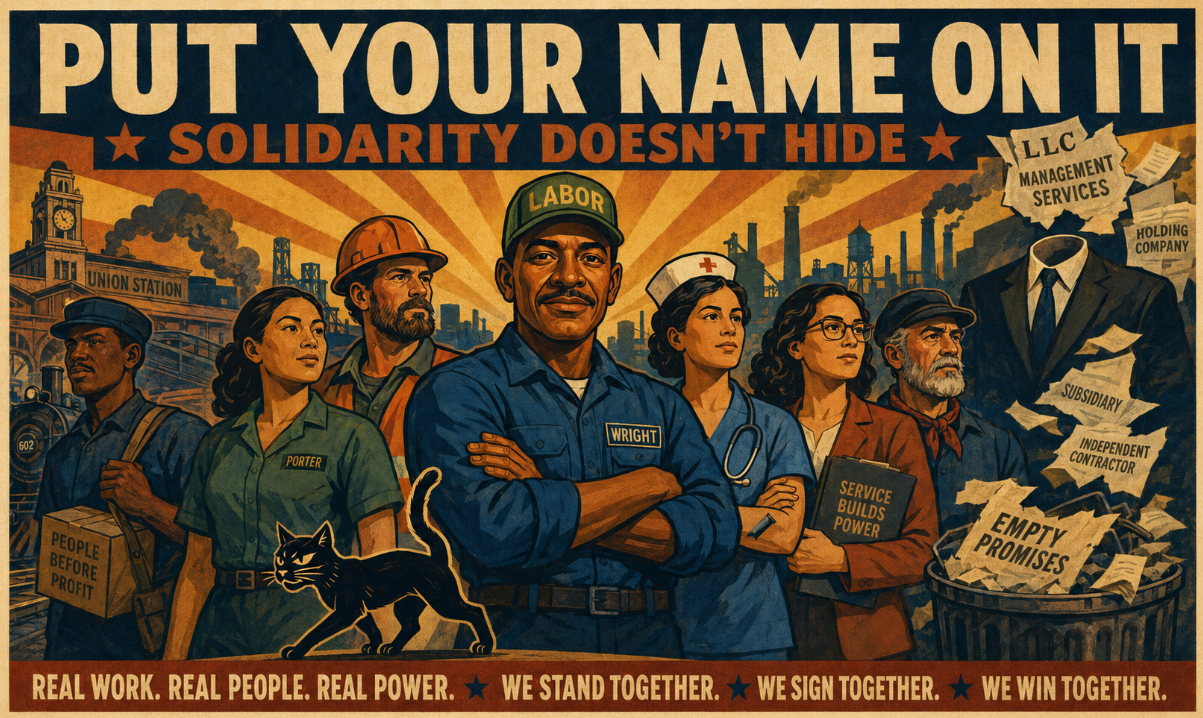
Name’s Wright. Mister Wright if you’re clocked in.
I’m writing this in the days between two anniversaries. Behind me, August 25, 1925, a hall in Harlem, a room of porters and a man named A. Philip Randolph telling them a union was how they’d get their manhood back on the books. Ahead of me, the March on Washington for Jobs and Freedom. My father named me for the man who did both. When I got sloppy he’d call me Mr. Randolph and let the silence do the rest.
So I’ve had the name on my mind. And I’ve been thinking about what it costs a man to put his own on something.
Randolph stood up in that hall knowing the company had ears in the room. They almost certainly did. He gave his name anyway. Signed it to the thing. Every man in there could be fired for having heard him say it, and he said it out loud with the lights on.
Now let’s talk about what the Pullman Company did.
They didn’t come stand in that hall and make their case. They built an organization — a Porters and Maids association, company-funded, company-approved, wearing the shape of a union and doing management’s talking. A voice for the men, run by the men who paid the men. They put the workers’ name on management’s furniture.
That is what I’d call a coward’s move. A man with a good argument makes it in his own voice.
The count
Porters balloted through May and June of 1935. The Brotherhood took it 5,931 to 1,422. Out of 8,316 eligible, and the company’s organization carried a majority in three cities in the whole country.
Four to one against the man who signed the checks.
Understand what that number is. It isn’t enthusiasm. Those men had every reason to be careful. The same period’s survey put a porter’s income at $880 for the year — sixteen ninety-two a week, $237 collected in tips and $236 of it spent right back out on the costs of doing the job. He worked twelve months of gratuities to break even on his own shoe polish. He had a family. He had a house note. He had a supervisor who could end him on a whim.
And the outfit across the ballot from him existed for one purpose: to make sure he answered as an individual instead of as a body.
That’s the whole game, and it has been the whole game since men first hired men. Get them answering one at a time. A man alone can be reasoned with, waited out, made an example of, transferred, forgotten. Six thousand men holding the same position at the same hour are a fact of nature. You negotiate with a fact of nature. You don’t reason with it.
The contract came August 25, 1937, twelve years to the day from that meeting. First of its kind between a major American corporation and a union of Black men. It came because they stopped letting themselves be counted separately.
Same trick, new paper
I’ve been reading this month about roughly 1,300 delivery drivers who lost their work when thirteen contracting outfits went down at once. The corporation whose vans they drove, whose uniform they wore, whose software wrote their routes and whose quotas set their day, says those weren’t its people. They belonged to the thirteen. And the thirteen are gone.
Thirteen. Not one — thirteen. So the drivers were split across thirteen employers before the first one ever folded.
Ninety years and the tool got better looking. Same tool.
Here is my objection, and I want to be precise about it, because I’m not against a man making a dollar and I’m not against management as a trade. I’ve stood on both sides of that table and I’ve worked for good bosses and I’d do it again.
My objection is to hiding. If you set the routes, you’re the boss. If you set the quota, you’re the boss. If you can end the business with a phone call, you’re the boss. Come stand where the light is and be the boss. Argue for your position with your own name on your own letterhead and let the men decide what they think of it.
A company that builds a paper man to stand in its place has told you it doesn’t believe its own case will survive being made in public. That’s the confession. Read it that way.
Our end of it
Now I’ll audit our own house, because a man who won’t do that has no business auditing anybody else’s.
When Randolph built the March on Washington for Jobs and Freedom, the AFL-CIO declined to endorse it. Affiliates showed up. The federation sat down. Labor split itself on a march with jobs as the first word in the title.
We’ve done the dividing to ourselves, is what I’m saying. Craft against craft. Local against local. Old hands against the new ones. The man in the office against the man on the floor, when both of them get the same letter on the same morning. Every hour we spend sorting each other is an hour management doesn’t have to spend doing it.
Randolph stayed inside that federation for forty years and kept correcting it from the inside. That’s the harder discipline. Walking out of a room is easy work.
So
They can’t cheat six thousand men the same way they can cheat one. That isn’t inspiration, it’s arithmetic, and it held in 1935 when the men doing the counting had $16.92 a week and everything to lose.
Find the man next to you. Learn his name and give him yours. Ask whose paper he’s on and compare it to yours. When somebody tells you the ownership is complicated, understand you’re being counted separately, and understand somebody chose that on purpose.
My father put it shorter. We carried other folks’ baggage, son — but never their shame.
Put your name on it. Both of you.
Now you know, Jack.