Our Happy Orang piece made the case for a better press: get more oil out of the palms already growing, and fewer forests have to be cleared for new ones. Writing it got us thinking about the old men of the forest from the other end. A better press eases pressure on the forest that’s left. It does very little for the orangutans who have already lost theirs, and it leaves the oil palm growing in the same places the orangutans need.
So we asked a different question. What would it take to grow the palm somewhere else?
A palm house in the Gulf South
The African oil palm wants steady heat, heavy humidity, strong sun and soil that stays moist without drowning. Southern Louisiana, east Texas and southern Arkansas already supply that for much of the year. What they lack is a winter that stays warm. Oil palms slow down when the temperature drops into the 60s, and a January night in Little Rock or Beaumont runs well below that.
Closing that gap takes a building. A full-grown oil palm can top 60 feet with fronds longer than a pickup truck, so a farm greenhouse won’t do. Picture instead the great palm houses of the Victorian botanical gardens: brick walls rising 15 to 25 feet, steel framing above, and a glass roof peaking 80 to 90 feet over the floor.
The brick earns its place. It stands up to Gulf Coast wind better than a glass skin, holds the day’s heat into the night like a stone hearth after the fire’s out, and gives the building a footing meant to last as long as the trees. Palms reach for overhead light anyway, so the roof does the work of gathering the sun.
Inside, the palms grow in deep, living soil with drip irrigation, drainage that keeps water on site, and harvest catwalks up in the canopy. Pollination happens by hand, with pollen collected from the male flowers and dusted onto the female ones. Ripe bunches go straight to a press room next door, where they’re steamed, pressed and clarified into red palm oil. Each liter traces back to a tree on a lot that held no forest, because the campus goes on land that’s already been cleared, paved or worked out.
Real palm oil, from real palms, grown where it costs no orangutan its home.
Built for the canopy
That got us thinking about the orangutans themselves, and the ones already living in buildings.
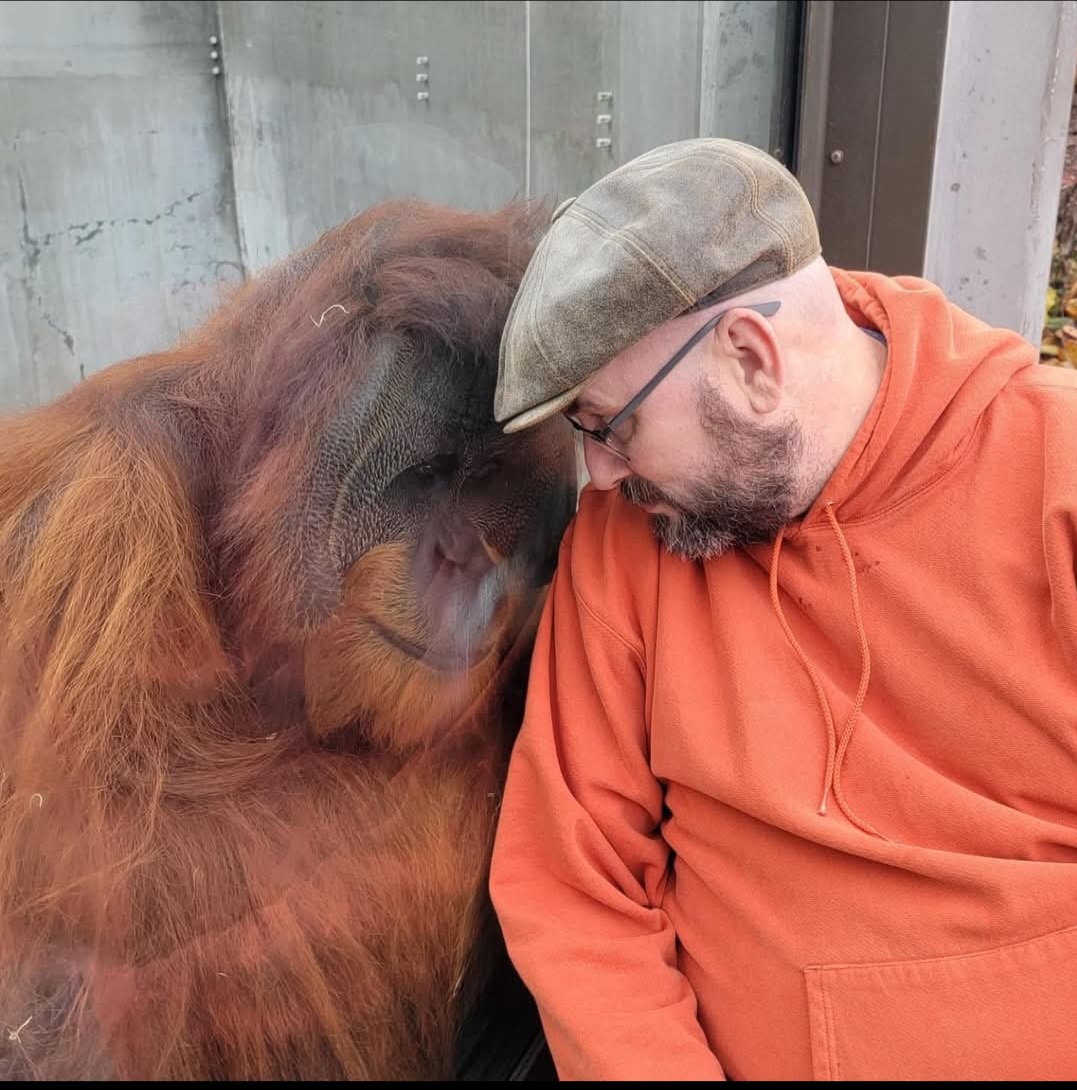
That’s me at the top of this page, forehead to the glass with a big flanged male on the other side. Good zoo, good keepers, a cared-for animal. Still a pane of glass, a concrete wall and a ceiling.
Orangutans are the largest tree-dwelling mammals on earth, and field researchers have recorded wild ones spending upward of 86 percent of their time off the ground. They travel hanging from their arms, spreading their weight across branches that bend under them, the way a man crosses a rope bridge by keeping a hand on each line he can reach.
Zoo life tips that balance toward the floor. Researchers at Apenheul Primate Park in the Netherlands found captive orangutans spend more time on the ground and less time moving than wild ones, and climb with different postures when they do climb. Those researchers pointed to a slow metabolism as the catch. An animal tuned to get through lean fruit seasons, sitting on a floor eating reliable meals, puts on weight like a retired lineman.
Good zoos know this and work at it. A later Apenheul study found that flexible structures like ropes drew out more of the natural hanging-and-swinging movement, though still well below what wild orangutans do. Auckland Zoo strung an overhead line pathway across its enclosure, and researchers found the orangutans used it about as often as chance would predict, with each animal settling into its own favorite corners and heights. A thesis on those same enclosures concluded that the managed zoo setting holds back natural behavior in apes, innovations or no.
A zoo is a city property juggling dozens of species for acreage and capital money. The orangutan house gets so many feet of height, and the rest gets made up with ropes, puzzle feeders and a keeper’s ingenuity.
The same building does both jobs
The palm house needs an 80-foot ceiling for the trees. That ceiling happens to be what an orangutan wants to climb into.
Put the two on one campus and the economics start pulling in the same direction. The production groves pay for the engineering: the masonry, the glass, the climate systems, the storm hardening, the staff who know how to keep a tropical room running through a Gulf Coast winter. The sanctuary conservatories ride along on that investment, with living trees, rope runs and nesting platforms reaching up 70 feet instead of 20. Elevated passages could connect one sanctuary house to the next, so a resident can choose his company and his view, while the harvest floors and press rooms stay walled off from the animals.
The sanctuary would be built for orangutans who can’t go back. Rescued orangutans in Indonesia and Malaysia belong in rehabilitation and release programs there. The Gulf South campus would serve the ones who need lifelong care, following the path the Center for Great Apes in Florida has already walked.
The business has several ways to earn its keep:
Palm oil. Traceable red palm oil and refined oil from palms that displaced no forest, with a story a buyer can verify tree by tree.
Visitors. People pay to walk through a great palm house. A tropical conservatory campus in the American South, with viewing galleries into the sanctuary designed so the residents can choose to be out of sight, draws the same crowd that fills botanical gardens.
Zoo partnerships. Zoos place individuals who would do better with more room, such as aging males or animals that don’t fit a social group, and pay a care fee the way a family pays a good care facility. The zoo keeps its relationship with the animal and its education program, and the orangutan gets a ceiling he can’t see from the floor.
Research. Universities studying locomotion and welfare in a large climbing space, and agronomists working out palm production under glass, both need somewhere to work.
A share of that income goes back to protecting standing forest in Borneo and Sumatra, which keeps the wild orangutans where they belong.
Two problems, one roof
The forest problem and the zoo problem come from the same root. Orangutans need height and green, and people keep handing them less of both. A campus that grows palm oil where it costs no habitat, and houses displaced orangutans in buildings sized for trees, answers both with one set of walls.
The old man of the forest may get his canopy back from the same palms that cost him the first one.
Sources (palm and climate figures came through the Brobot groundwork and need checking before publishing):
- FAO EcoCrop entry for Elaeis guineensis (temperature tolerances)
- Royal Botanic Gardens, Kew, plant profile for Elaeis guineensis (tree and frond size)
- National Weather Service climate normals for Little Rock, AR and Beaumont/Port Arthur, TX (January lows)
- Center for Great Apes, Wauchula, FL
- Roth, T.S., Bionda, T.R. & Sterck, E.H.M. (2017). “Recapturing the canopy: stimulating Bornean orang-utan natural locomotion behaviour in a zoo environment.” Journal of Zoo and Aquarium Research 5(1), 16–24.
- Animal Welfare (Cambridge University Press): Apenheul study comparing flexible and rigid enclosure structures
- Steiner, H., Malone, N. & Battles, H.T. (2025). “Preferential space use exhibited by individual orangutans in an innovative enclosure at Auckland Zoo.” Journal of Applied Animal Welfare Science 28(4), 703–714.
- University of Auckland thesis, “Going Above and Beyond? An Analysis of Ape Behaviour and Space Use in an Innovative Captive Setting”