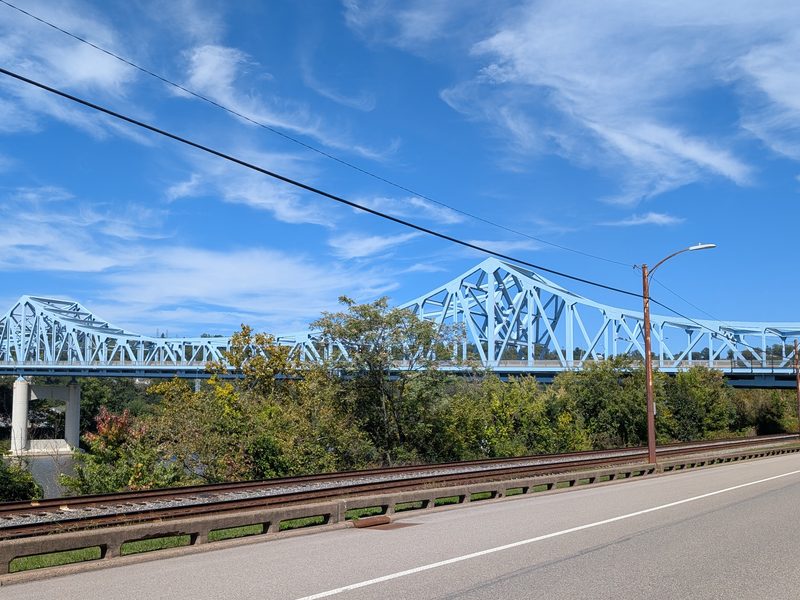
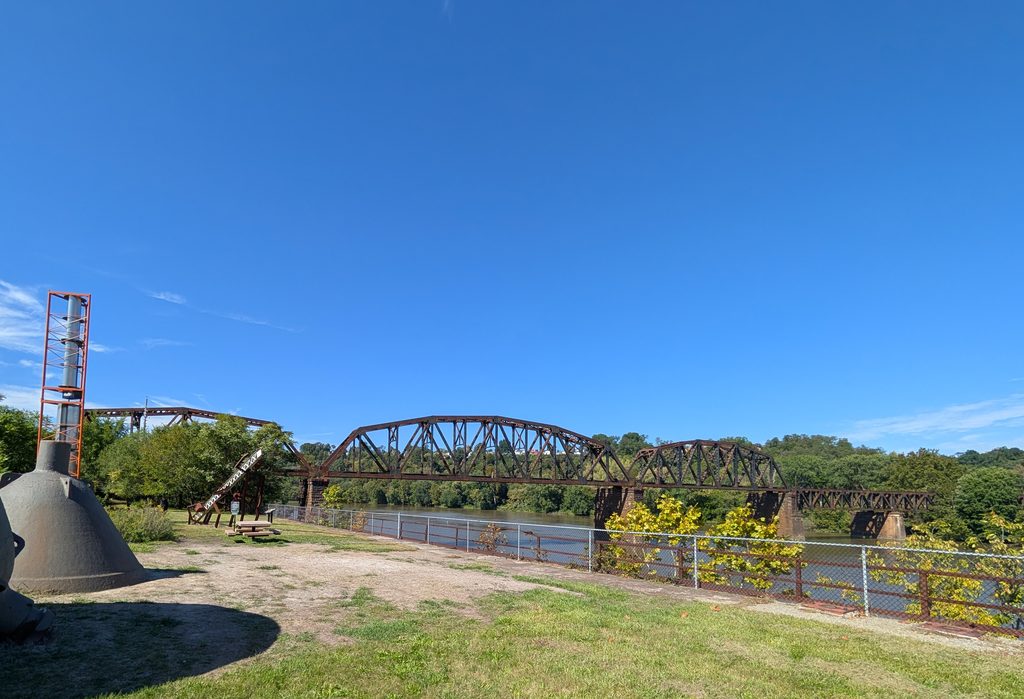
The tower sits on an octagon of red brick, a riveted steel drum shedding white paint in long rust tears. At its foot, a big blue U.S. Steel medallion reads “In Honor of the Employees.” Across the Monongahela, the old Carrie Furnaces stand against the sky like a pair of retired boxers who still keep their hands up. A railroad truss crosses the water on brick piers. On a clear October afternoon it’s a pleasant place to sit, and people eat lunch at the picnic table by the fence.
On July 6, 1892, men died on this riverbank.
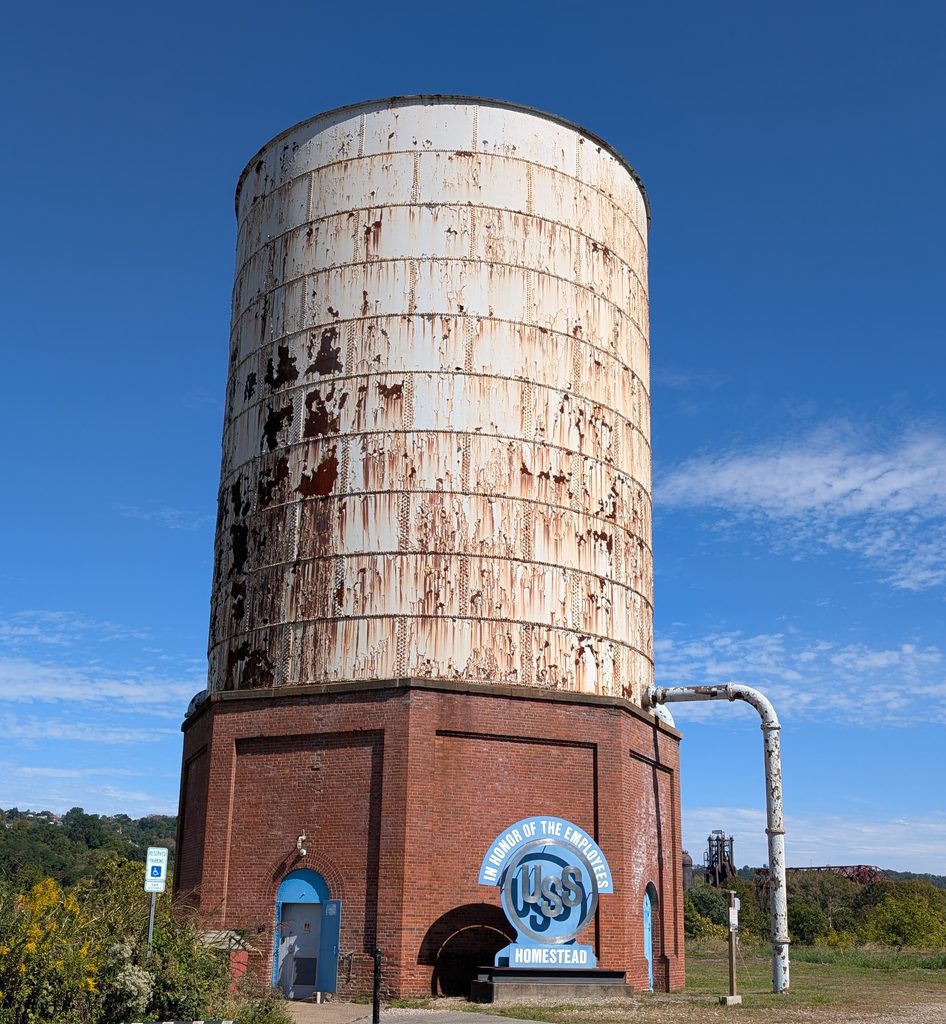
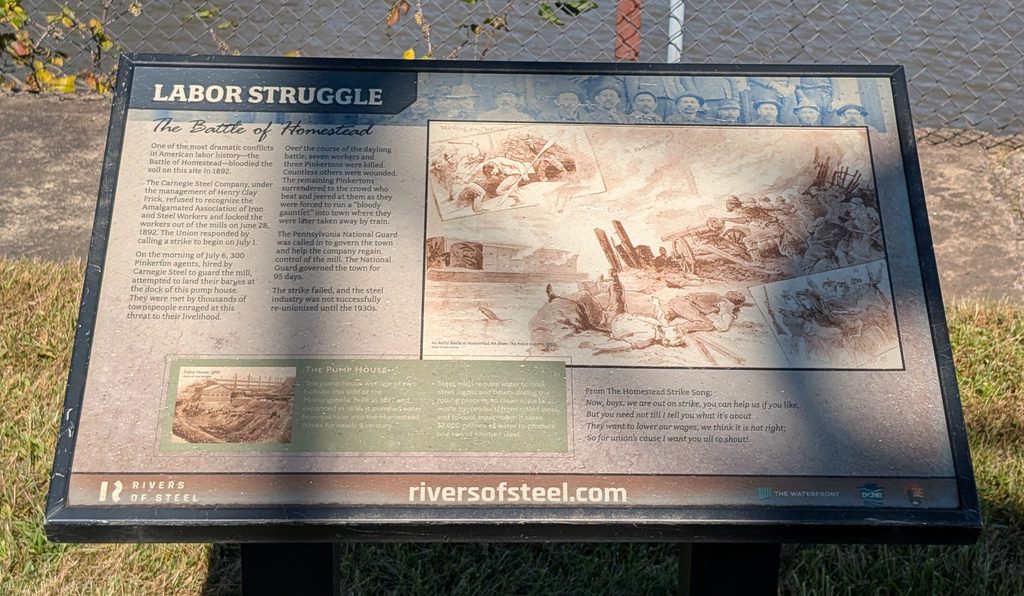
The pump house went up in 1892 and was enlarged in 1896, one of two on this side of the river. Its job was plain work: pull water out of the Mon and push it into the Homestead Works, where ingots and billets needed cooling, rolled steel needed its scale washed off, and the machinery needed relief from its own heat. The placard puts the thirst at 32,000 gallons of water for one ton of finished steel. The building kept that up for close to a century. It also had a dock, and the dock is why we remember it.
That summer the Carnegie Steel Company, managed by Henry Clay Frick, refused to recognize the Amalgamated Association of Iron and Steel Workers. On June 28 the company locked the men out. The union called a strike for July 1. On the morning of the 6th, 300 Pinkerton agents hired to hold the mill came up the river on barges and tried to land here. Thousands of townspeople were waiting.
The fight ran through the day. Seven workers and three Pinkertons were killed, and many more were wounded. When the Pinkertons surrendered, the crowd beat and jeered them through a gauntlet into town before they were taken away by train. The Pennsylvania National Guard came in, governed Homestead for 95 days, and helped the company take back its mill.
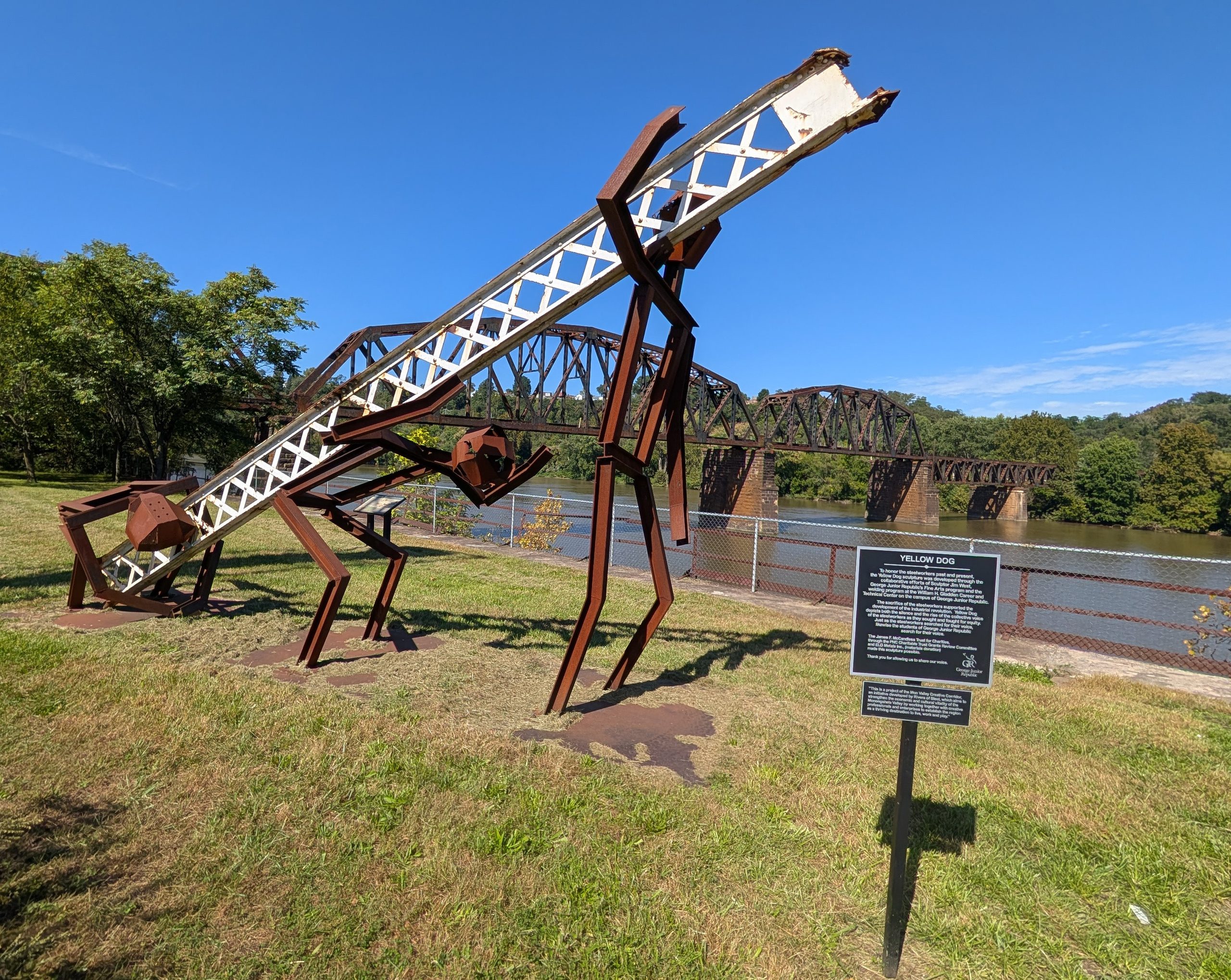
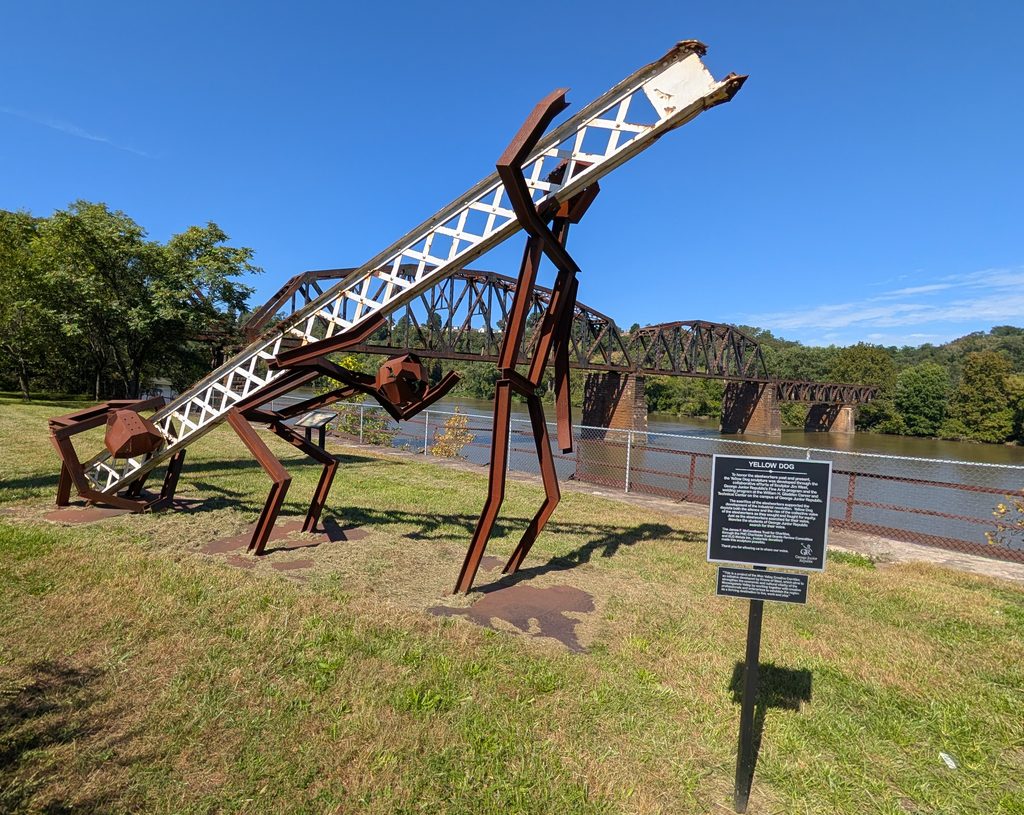
Yellow Dog stands on the lawn near the fence: rusted steel stick figures heaving a long white lattice girder up out of the grass. Read left to right, it works like a time-lapse of a man getting up off his knees. One figure crouches low by the foot of the beam, the next bends into the load, and the last stands upright with the girder on his shoulder. Sculptor Jim West built it with students from George Junior Republic’s fine arts program and the welding program at the William H. Gladden Career and Technical Center. Its plaque says the piece depicts both the silence and the rise of the steelworkers’ collective voice, and it pairs those workers’ search for a voice with the students’ search for their own. The title points back to the yellow-dog contract, the pledge a worker signed promising to stay out of the union as a condition of getting hired.
Then there’s the tower. The logo of the corporation that absorbed Carnegie Steel nine years after the battle now thanks the employees at the same dock where the company’s hired men tried to come ashore. It feels like a family reunion held at the site of an old fistfight, with everyone agreeing to admire the view.
History likes a clean villain, and this site comes closer to handing you one than the lunch crowd might guess. The townspeople on that bank knew who Frick was. Fifteen months earlier, during a strike at the H.C. Frick Coke Company works at Morewood, armed men fired into a crowd of about a thousand marching strikers. Seven died that day and two more afterward. Frick cabled Carnegie that the coke victory was complete. So when barges full of hired guns came up the Mon in his name, the crowd read it as a repeat of something they had already seen. Frick and Carnegie were ruthless businessmen using force as leverage, and Homestead had good reason to believe that force would be pointed at them.
The workers did what labor is supposed to do. They stood up for themselves and for each other, and a town turned out on the riverbank to back them. That part earns the plaque. Then the crowd ran the surrendered Pinkertons down the gauntlet, and a story about men defending their homes started to look like a story about a mob.
Even so, the strikers still had a share of public sympathy through mid-July. On July 23, Alexander Berkman, an anarchist from New York with no ties to the Homestead men, walked into Frick’s downtown Pittsburgh office, shot him twice and stabbed him. Frick survived, and by most accounts finished his workday at his desk before going home. Berkman meant to spark a workers’ uprising. What he delivered was a wounded executive the newspapers could sympathize with and a reason to lump the union in with assassins. The strike collapsed that fall, and steel stayed unorganized until the 1930s.
It’s a weird monument to an uncomfortable moment. The men who held that riverbank lost their fight to a man who had already shown what he’d do to win, and the blow that finished them came from someone who never worked a shift at Homestead.
Sources
- Rivers of Steel interpretive placard, “Labor Struggle: The Battle of Homestead,” Pump House site (riversofsteel.com)
- Yellow Dog sculpture plaque, George Junior Republic / Mon Valley Creative Corridor, Rivers of Steel
- Pennsylvania Historical and Museum Commission marker, “Morewood Massacre,” Route 981, East Huntingdon Township
- ExplorePAhistory.com, Morewood Massacre marker pages
- Site visit and photographs, October 2026