The house everybody wants to call a Craftsman, and the two reasons it isn’t
The first instinct is to call it a Craftsman. Two stories, no turret, no witch’s-hat spire, no steep theatrical peaks stabbing the skyline — the silhouette sits lower and calmer than the high-Victorian houses we file under Queen Anne. So the eye reaches for the next available label, and on a street in this part of the country, the next label is Craftsman.
The eye is wrong on two counts.
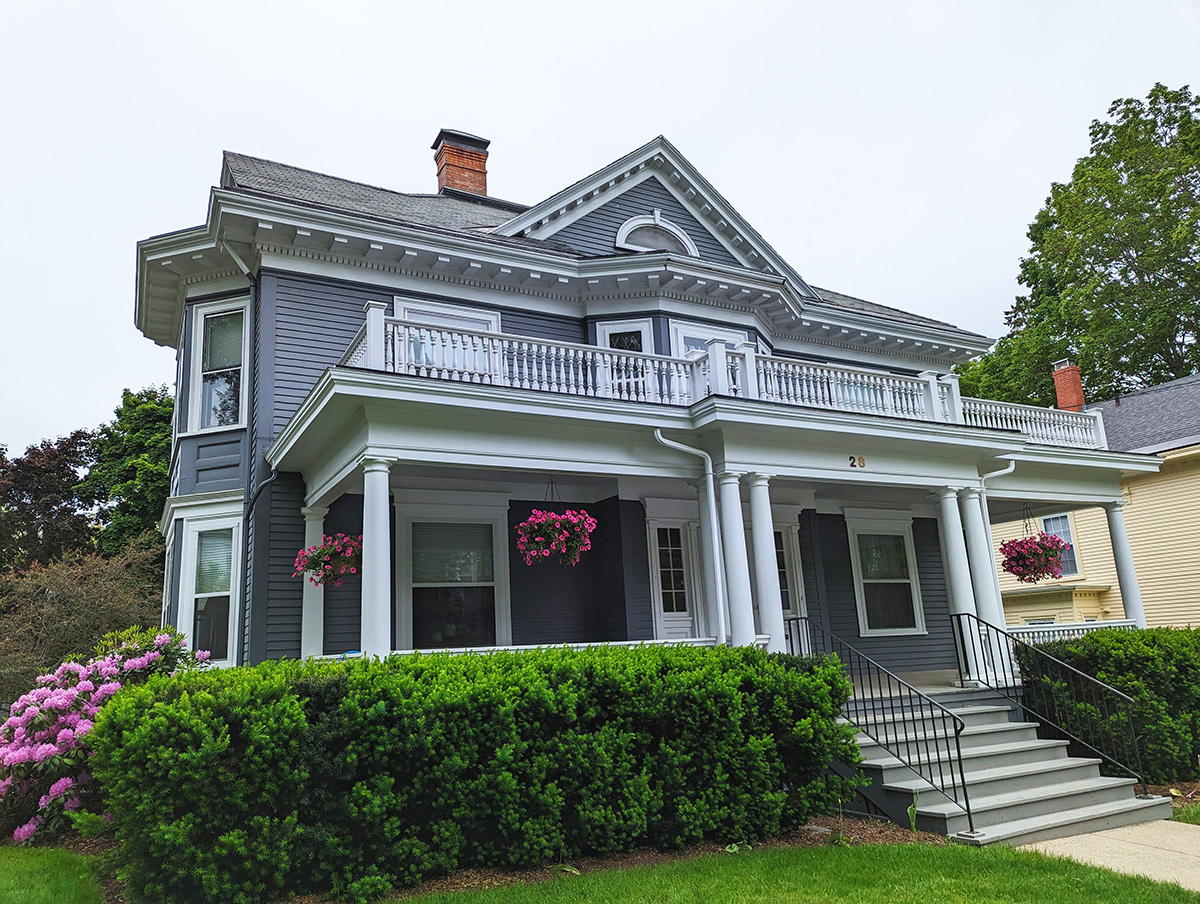
Count one is the vocabulary. Strip the theatrics away and you still have a polygonal corner bay climbing two full stories, an asymmetric roofline with a cross-gable riding on a hip, and ornament packed into every horizontal run. That is Queen Anne bone structure. What scrambles the read is that the ornament isn’t the spindled, turned, gingerbread kind we associate with the style — it’s classical. Paired smooth columns where you’d expect lathe-turned posts. A dentil-and-modillion cornice marching the length of the eaves. A round window set into the front gable, doing the work of a stripped-down Palladian flourish. A turned balustrade fencing the upper deck. Virginia McAlester’s field guide has a name for exactly this marriage of Queen Anne massing in classical clothes: Free Classic. About a third of all Queen Anne houses live there. This one is Free Classic leaning hard toward Colonial Revival, which puts it somewhere around 1895 to 1910.
Count two is the calendar, and it settles the argument. The Craftsman house as a national idiom doesn’t really arrive until after 1905, rides Stickley’s magazine and the California bungalow through the 1910s and twenties, and runs on the opposite philosophy entirely — low, horizontal, informal, earth-toned, with eaves you could shelter under and rafter tails left honest and exposed. A house built at the turn of the century, dressed in columns and dentils and built to stand up straight, was finished before that wave broke. Calling it Craftsman isn’t only the wrong grammar. It’s the wrong decade.
And then the porch. Or rather the porches, because the move that makes this house is the full-width classical porch with a second, open, balustraded porch standing on its roof. Porch on porch. That stacked arrangement is the whole thesis of the building. The ground-floor porch is the parlor turned inside out, the place where the household met the street. The deck above it is a stage. You went up there to be seen from the sidewalk and to watch the sidewalk see you. This is a social home in the most literal sense — architecture built around the transaction of seeing and being seen, from a time when a front elevation was a family’s public face and a Sunday afternoon on the upper balcony was a form of address. Nothing else on the house earns its keep the way those two tiers do.
On construction it grades high. The dentil course and the modillion brackets alone represent a punishing amount of repetitive millwork, all of it crisp. The deck balusters are turned one at a time. The bay framing is clean, the gable returns are correct, the cornice carries around the corner without losing its line. This is carpentry done by people who expected it to be looked at closely and priced the job accordingly. A hundred-odd years on, it is still holding its edges.
Which is what makes the paint a small heartbreak. One deep slate gray on the body, white on the trim, and that is the whole scheme. It is tasteful. It photographs well. It is also two values doing the work that used to take five. The point of all that carpentered detail was for the detail to read — the dentils, the brackets, the porch frieze, the column capitals, the balustrade, the window sash, each carrying its own color and announcing itself across the street. The old painters understood the millwork was an argument, and they made every piece of it speak. Nobody paints the highlights anymore. We buy these beauties for their bones and then paint over the jewelry. They were built to be polychrome, and we keep handing them the gray suit.