Sit down a minute. Get some water first — I mean that. It’s July, and July doesn’t negotiate.
I’ve been watching the thermometer and the news at the same time this week, and the two of them have been telling the same story. Down in Philadelphia, sixteen hundred utility workers walked off the job at one minute past midnight on the Fourth of July. First strike in that company’s hundred and forty-five years. Linemen, gas techs, call center folks — the whole shop. And here’s the part I want you to hold onto: locals up and down the coast, six states’ worth, told their members don’t touch that company’s work while our brothers and sisters are out. One Teamster put it plain: labor sticks with labor.
Three days. That’s all it took. Three days of a united line in the summer heat, and those workers walked back in with their pensions restored. Defined benefit. The kind your grandfather had and your generation was told to stop dreaming about. Turns out it wasn’t a dream. It was a negotiation, and somebody finally showed up to it with everybody behind them.
Now, some of you younger hands might think that’s a fluke of the season. It isn’t. July has always been labor’s forge. The heat cooks the grievances that management left sitting all spring.
A hundred and forty-nine years ago this very week, in July of 1877, railroad men in Martinsburg, West Virginia took their second pay cut in a year and said no more. That no ran down the rails like fire down a fuse — Baltimore, Pittsburgh, Chicago, St. Louis. The first strike this country ever had that stretched from one ocean’s ambition to the other’s. They didn’t win everything. Most first fights don’t. But every union man and woman drawing a fair wage today is standing on track those men laid in that heat.
And in July of 1959 — the fifteenth, to be exact — half a million steelworkers walked out of the mills and stayed out a hundred and sixteen days. Longest big strike in our history by days on the line. They held. Their families held. And the contracts that came out of that fight fed a generation.
So when I tell you summer boils talks over, I’m reading the record, same as I read a blueprint. Heat finds the weak weld. Always has.
But July keeps another ledger too, and this is why I asked you all to gather up before the shift.
On July 12th, 1917, in Bisbee, Arizona, two thousand deputized men rounded up nearly thirteen hundred striking copper miners at rifle point, packed them into cattle cars — cattle cars, in Arizona, in July — and hauled them a hundred and eighty miles into the desert. Left them there without food, without water, meant to be broken or buried by the sun. Two men died in the roundup. The rest survived because soldiers found them before the desert finished the job somebody started. Nobody ever answered for it. Not one conviction.
And on July 17th, 1944, at Port Chicago, California, three hundred and twenty men — most of them young Black sailors loading munitions with no proper training, because the Navy hadn’t seen fit to give them any — were killed in a single instant when the pier went up. The men who survived and refused to go back to unsafe work were charged with mutiny. Took fifty years for the country to start saying what those men knew standing on that dock: the working conditions were the crime.
I’d ask you to take a moment of silence with me now. For the miners in the desert. For the sailors on the pier. Take your hats off if you’re wearing them.
…
All right.
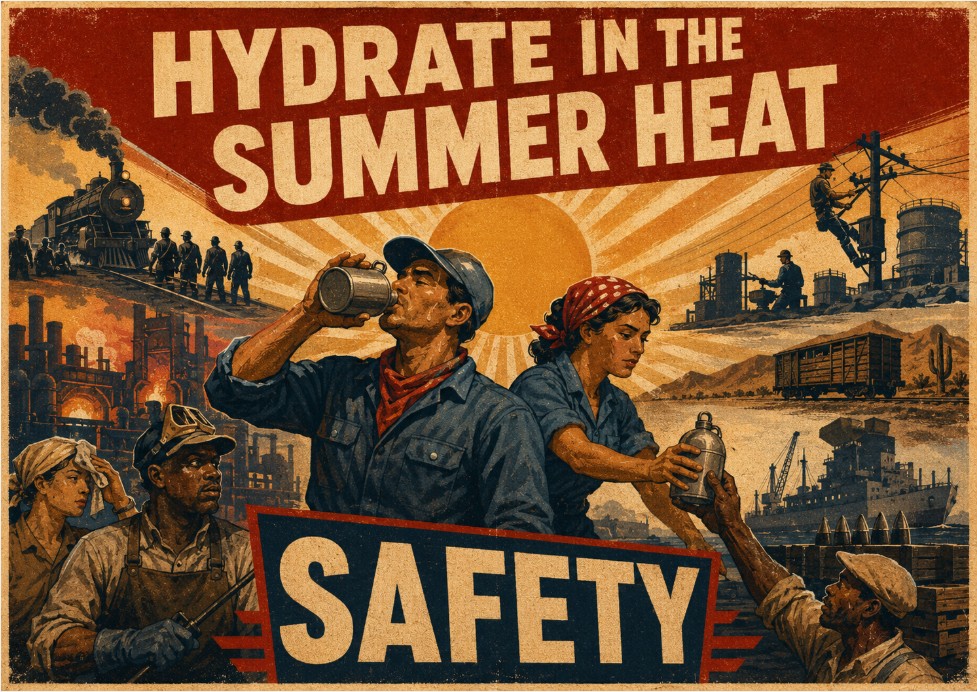
Now here’s the prayer I want you to carry out of this moment, because those men don’t need our tears — they need our vigilance. Work safe today. Check your gear, check your partner, check your corner of the shop. And when something isn’t right, insist. Say it to your steward, say it to your foreman, say it as many times as it takes. Insisting on a safe shop is how the living honor the dead in this trade. Every guard rail, every lockout tag, every man who goes home whole at the end of the shift — that’s a memorial that breathes.
Respect is the first safety rule. My old man taught me that carrying other folks’ baggage on the sleeper cars, and July teaches it again every year, in triumph and in mourning both.
Drink your water. Watch your people. Do it the Wright way.
Now you know, Jack.