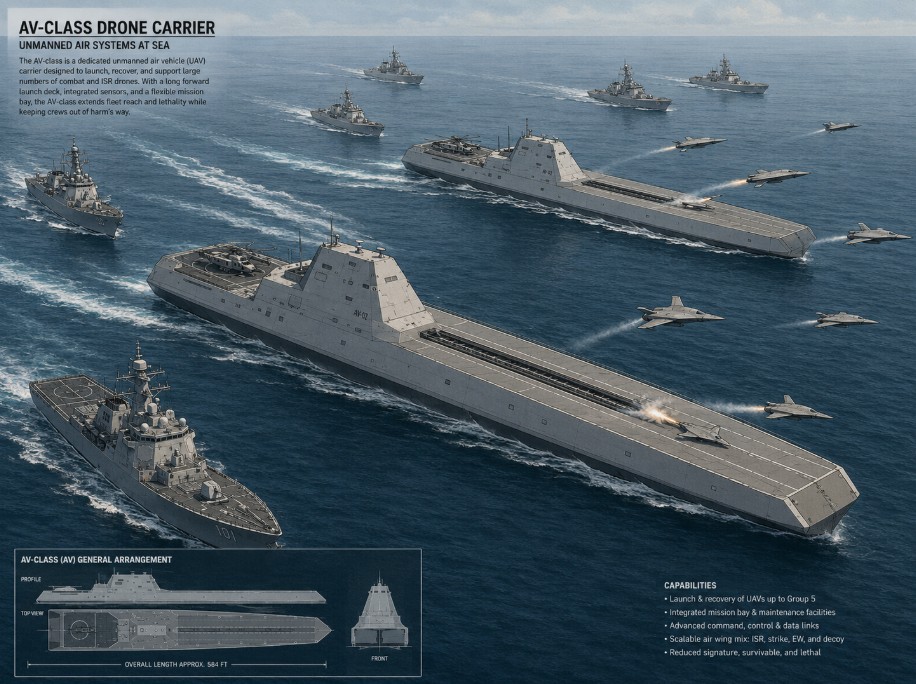
Observe / Design / Intervene
Forward vision, reachback control, and what a production ship does for a fleet
OBSERVE
Correcting the frame
The first AV piece argued for a production hull as an amphibious enabler. A reader could come away thinking the concept is about substitution — that a factory ship arrives and something else leaves.
That reading is wrong, and it is the reading that gets concepts killed. Every officer whose community would supposedly be traded away becomes an opponent, and the argument turns into a budget fight before anybody examines whether the capability is real.
The honest version is simpler. There are things a fleet wants continuously and cannot currently afford to have continuously, because everything that provides them is scarce, expensive, individually tracked, and flown by people who have to sleep. A production hull fills those gaps. Nothing leaves. The formation gets capabilities it does not now possess and gets them at a price that makes their routine use unremarkable.
There are five such gaps, and they are unrelated to each other in every way except that one hull answers all of them.
Gap one: forward vision
A strike group commander would like to know what is on the surface within a hundred miles, continuously, in weather, without emitting, and without spending anything scarce to find out.
Nothing in the fleet provides that. The E-2D provides a superb air picture on a small number of sorties per day. Helicopters off the escorts provide short-range coverage on airframe hours that are always contested. Maritime patrol arrives from shore on somebody else’s schedule. National assets pass overhead on an orbit the group does not control and an adversary can predict. Each of these is excellent and each is rationed.
The result is that formations move with a surface picture assembled from radar returns, AIS, intelligence products of varying age, and inference. It works. It has worked for decades. It also means the difference between a merchant, a fishing fleet, and something else is frequently resolved by sending an expensive aircraft to go look, which the group does sparingly because the aircraft is scarce.
Persistent low-altitude electro-optical coverage at a hundred miles is not a substitute for any of that. It is a layer nobody has, filling the space between the radar horizon and whatever the overhead architecture provides.
Gap two: the middle of the range band
There is a band in surface warfare between roughly the horizon and a couple hundred miles where a formation’s only tools are things that cost a great deal per shot.
Inside the horizon there is a gun, which is cheap per round and short-legged. Out past that, engagement means a missile, and the cheapest useful ones are priced like a house while the serious ones are priced like several. That pricing is correct for the targets they were designed against. It is badly wrong for a fishing boat with a machine gun, an unmanned surface craft, a small swarm, or any of the low-end problems the last three years have made routine — and the Red Sea demonstrated exactly what it costs to answer cheap things with expensive ones.
A formation that can put fifty small aircraft down a bearing at feedstock cost has an option in that band it does not currently have. This is a magazine-economics argument rather than a weapons-design one, and the guardrail from the first piece stands unchanged: the production line makes airframes and adapter plates. Ordnance lives in a separate space, under magazine rules, with its own people. The line never touches it. That separation is what keeps the production decks defensible in a general arrangement review, and it is also the honest way to talk about the capability in public.
The point is not that a drone is a better weapon than a missile. It is that a formation which can only choose between a gun and a million-dollar round is going to keep making the wrong choice, and that a third option in the middle changes the arithmetic of a long campaign.
Gap three: rescue
This one is unglamorous and it is the gap I would lead with if I were briefing a fleet commander who had recently lost somebody.
A man overboard, a downed aircrew, a mass rescue after a collision, a sinking merchant, migrants in the water. The response is a helicopter, which takes time to spin up, has a search rate limited by one crew’s eyes, and cannot fly in everything. Survival time in cold water is measured in tens of minutes.
Small aircraft flying an expanding-square search change the math in two ways. First, coverage rate: twenty aircraft searching simultaneously cover ground no single helicopter can, and they can be airborne in the time it takes to walk to the launch rail. Second, the drop. An aircraft that reaches a person in the water in eight minutes and puts a floatation device, a strobe, and a radio beacon within a few meters of them has changed a survival problem into a recovery problem, and the helicopter that arrives later flies to a coordinate instead of to a search area.
The sensing side is genuinely mature. Work published this February demonstrated real-time detection and tracking of people in distress at sea from a UAV, with onboard thermal and posture analysis running at video frame rates on embedded hardware, reporting detection accuracy in the mid-eighties for swimmers in field trials — with the honest caveat that thermal detection at sea has real limits, and low contrast between a person and the surrounding water constrains the usable altitude, which argues for many aircraft low rather than a few aircraft high. That is the profile a production ship generates naturally. arxiv + 2
The rest of the world is already moving. The Coast Guard put out a request this April for contractor-owned, contractor-operated drone services flown from cutters and shore sites, explicitly including detection of people in the water needing rescue alongside surveillance of low-profile smuggling vessels, with the systems also expected to serve as communications relays. The requirement is recognized. What is missing is a source that can put the aircraft in the water in quantity without a contract vehicle. ScienceDirect
Gap four: undersea search
Aircraft do not hear submarines, and any concept that claims otherwise deserves the reception it gets.
What a small aircraft does is carry and place things. Strip a sonobuoy to its parts and you have a float, an antenna, a battery, a descent device, and a hydrophone with its processing. Everything on that list but the last item is structure, and structure is what this ship makes. The dependency logic from the first piece transfers without modification: import the sensor module, produce the body, assemble on the line.
Why that matters is a supply problem rather than a technology problem. Sonobuoys run from around eight hundred dollars to just under ten thousand each depending on type, and Ultra reported its production facilities operating at essentially full capacity in early 2024, with order fulfillment delays following. Meanwhile the Navy dropped the LCS anti-submarine warfare mission package in 2022, shifting ships marked for that mission over to surface warfare or mine countermeasures, and nothing has arrived to replace it. Navy Lookout + 3
So the barrier and area-search side of ASW is currently limited by a factory in Indiana and by how many P-8 sorties a theater can generate. A formation that can lay, refresh, and re-lay a pattern on its own initiative has coverage it cannot presently buy. It still needs the ship with the towed array, the helicopter with the dipping sonar, and the torpedo. Search and prosecution are different problems, and this addresses the first one.
There is a surface contribution too, which people forget because it sounds too simple. Diesel boats snorkel. Periscopes leave wakes. Persistent low-altitude optical coverage over water a formation is about to transit is a partial but real contribution to the undersea picture, and it is coverage nobody flies because nobody can afford to.
Gap five: proficiency
This is the argument that changes what the ship is, and it comes off the shop floor rather than out of a war college.
A production line staffed by people who have not run it in eighteen months is a room full of equipment. Manufacturing skill lives in the hands and in the informal knowledge that accumulates around one specific set of tools — that the forming press wants a different dwell time when the shop is cold, that station six has a fixture that walks, that the test cell throws false failures when the ship is rolling and nobody wrote it down. That knowledge decays on a schedule, and it decays fastest in exactly the people you need most.
The answer is not that the line runs around the clock. That would burn feedstock at a rate no peacetime logistics train would tolerate, and it would produce articles nobody asked for.
The answer is that the line is maintained the way every other perishable shipboard skill is maintained, which is by drilling it.
Nobody fights fires continuously. A crew drills, qualifies, holds the qual, and when there is a real fire the party turns to and performs. Damage control, general quarters, casualty control, replenishment at sea — all of it runs on a cycle of scheduled evolutions punctuated by the real thing. The production department belongs on that same footing:
Station drills, run on a weekly rotation, exercising individual cells and the hand-build fallback without consuming a full kit.
Full-line evolutions, run at intervals, taking a batch end to end from kitting through functional test, proving the whole system including the forming shop and the test cells. This is the production department’s equivalent of a full-power run.
Demand runs, which are the real thing — the fleet needs articles, and the line produces them. Targets before a live-fire period, a saturation set before a counter-drone exercise, acoustic bodies before a search, magazine fill before a deployment.
Casualty drills, single-station down with a sailor standing in, forming press casualty, power loss to the deck. The degraded-operation figures in the original design exist to be exercised rather than assumed.
The drill schedule also runs the striker pipeline. Non-rated seamen and firemen rotating through stations is how the production deck feeds ET and EM, which converts equipment care from a discipline problem into a selection problem.
So the question is not what a ship does with five hundred airframes a day in peacetime. It is what the ship’s demand looks like across a cycle, and what the drill schedule costs. Both are modest, and both are familiar to anyone who has run a shipboard training plan.
DESIGN
Control is the multiplier
Every organic aviation concept since 1922 has run into the same wall: the ship can only fly as many aircraft as it can berth people to fly and maintain. Deck space, berthing, and aircrew rest have capped naval aviation for a century, and every attempt to raise the ceiling has meant a bigger, costlier ship.
Decouple the operator from the hull and the wall moves.
The Air Force has run this architecture for two decades. A launch and recovery element forward handles the aircraft physically; a mission control element half a world away flies the mission over satellite. The Navy has never adopted it, because carrier aviation is organic by doctrine and by culture — the aircrew live on the ship, eat in the wardroom, and are part of the crew.
For a production hull, organic control is a constraint with no compensating benefit. The people who matter aboard are the ones who build, maintain, and launch. The people flying can be anywhere with bandwidth.
The consequence is worth stating carefully, because it is the largest single idea in this concept. Sortie count stops being a function of the ship and becomes a function of how many operator seats the nation chooses to staff. A hull that can produce five hundred airframes a day is no longer limited to the number its crew can fly. It is limited by a shore pool that can be as large as anyone wants to make it.
That pool has properties a ship’s crew cannot have:
It follows the sun. Twenty-four-hour operations run on rotating day shifts across time zones instead of on watch sections fighting circadian rhythm at sea. Fatigue is the largest quiet contributor to error in sustained operations, and this removes most of it.
It surges without steel. Operator capacity can be built in a Reserve center at a fraction of the cost of a berth at sea, and expanded in a crisis by mobilizing people who already hold the qualification. Building sortie capacity without building ships is not a small thing to be able to do.
It does not require autonomy to mature. This is the part that separates the concept from every collaborative combat aircraft program currently competing for money. Those programs are betting on autonomy arriving on schedule. This one works at a one-to-one operator-to-aircraft ratio using 2005 technology plus bandwidth. If supervised autonomy improves and one operator can hold four or eight aircraft, the ratio gets better and nothing about the architecture changes. If it does not improve at all, the concept still functions. That is a rare position to be in.
The high-end demonstration already happened — a Marine Corps Valkyrie launched from a zero-length launcher in April, validated a beyond-line-of-sight datalink, and handed control from a ground station to an operator flying it over BLOS. The expensive version works. The argument here is that the cheap version works too, and that the cheap version is the one you can afford to fly ten thousand times. Unmanned Airspace
Three control modes, in descending order of contest
Bandwidth is a war-fighting assumption, and a concept that only works with clean satellite links is a concept that fails on day one against a serious opponent. So the architecture degrades deliberately:
Reachback. Satellite link, shore operator, full real-time control and sensor feed. Maximum utility, maximum vulnerability. Note who is emitting: the four-hundred-dollar airframe a hundred miles out, not the ship. The formation stays dark. This is the peacetime and permissive-environment mode and it is where most flight hours will be spent.
Local relay. Line-of-sight to a relay airframe, which links to the ship or to a shore node. Shorter reach, much harder to geolocate, and the ship still does not emit toward the fight. This is the contested mode.
Autonomous scouting. No link at all. The aircraft flies a briefed pattern, images, processes onboard, and returns with what it saw — or transmits a compressed burst on a scheduled window from a position well away from anything worth attacking. Scouting aircraft did exactly this in 1942 and the information arrived hours late and was decisive at Midway anyway. Latency in exchange for emissions discipline is a trade a commander should be able to make deliberately.
The cost of the reachback architecture belongs in the requirement rather than in a footnote. Satellite links are jammable and the constellations are targets. Latency complicates anything time-critical. There are also two decades of Air Force literature on what sustained remote operations do to the people flying them, and on the career and cultural friction between crews at risk and crews at home — which the Navy will experience in a sharper form, because the ship is inside the threat envelope and the operator is in a building.
The airframe family
Five or six variants on a common fuselage, differing in one or two molded parts, all built on the same ten-station line:
- Scout. Electro-optical and infrared, maximum endurance, recovery expected.
- Relay. Antenna and power, orbits high, extends everything else.
- Acoustic carrier. Places sensor bodies on a pattern; the body is produced, the module imported.
- Rescue. Floatation, strobe, and beacon in the payload bay, with a thermal sensor optimized low.
- Decoy. Cheapest article on the line, and arguably the highest-value one, because it makes emitters radiate.
- Effects carrier. Adapter plate ships empty; whatever mounts to it comes from the magazine and never touches the production deck.
New geometry arrives as a data file, prints as a pattern, casts as a soft tool, moves to hard tooling in the machine shop, and flies inside a week. That was the original argument for putting a tool room rather than a print farm at the center of the design, and it holds harder here — a fleet that discovers a gap on Tuesday can have an airframe addressing it by the following Monday.
Recovery, by container
Attrition assumptions differ by mission, so the hull carries three recovery doctrines and loads one:
- Contested assault: no recovery, maximum rate, airframe is consumable.
- Screening, rescue, and routine operations: recover everything, high cycle counts per airframe, line runs at replacement rate rather than capacity.
- Delivery: recover the aircraft, expend the payload.
Wire capture off a small ship has been in service for two decades; parachuted-payload-with-aircraft-recovery has been running at commercial volume for about ten years. Same tooling, same line, different container aft and a different watch bill. The flexibility lives in doctrine, where it is cheap.
The hull family
Several ship types will fall out of this, and it is better to anticipate them than to pretend one hull covers everything.
The fleet hull is the one described in the first piece — roughly 584 feet, three production lines, complement near five hundred, diesel-electric on twin screws, double-hulled with compensated tanks holding a narrow displacement band. This is the one that rides with a carrier strike group.
A smaller escort-sized hull, single line, in the range where a mid-tier yard can build several a year. It rides with a surface action group, an amphibious ready group, or an independent deployer that will never rate a fleet hull. It produces at perhaps a fifth the rate and covers the same five gaps at the scale that formation needs.
A civilian-flagged humanitarian hull — chartered, containerized, consortium-operated, unarmed, open to inspection, standing in international water. The first piece argued this at length and the argument is unchanged: its legitimacy comes from having no weapons capability to conceal, and that is verifiable from outside rather than asserted.
An undersea-weighted variant, trading production line count for module stowage and acoustic processing spaces, riding with an ASW-focused group.
The tooling, the ratings, the line layout, and the airframes are common across all of them. Only the hull scales.
What kind of ship this is
Somebody will say this is an auxiliary and belongs in the auxiliary conversation, filed with the oilers and the ammunition ships, somewhere behind the fighting.
They are right about the classification and wrong about what it implies, and the correction is worth making in the same breath, because the misunderstanding has cost people their lives and their recognition for as long as the Navy has had a supply train.
Combat stores ships went where the fleet went. Niagara Falls made her first deployment into Vietnamese waters in 1968 and supplied ships of the Naval Gunfire Support Group off the coast, ran replenishment swings through Yankee Station and the Market Time areas, and carried ten campaign stars out of that war. Her award record carries the Combat Action Ribbon, fourteen Republic of Vietnam Gallantry Cross Unit Citations, and expeditionary credit for Korea, the Persian Gulf, Somalia, and Bosnia. Crews across her thirty-odd commissioned years wear ribbons earned in different decades and different wars.
“Auxiliary” in the American naval tradition describes what a ship carries, not how far from the shooting she operates. The AE, the AO, and the AFS all went alongside combatants inside the threat envelope, because underway replenishment happens where the fleet is and the fleet is where the fight is. The AS did her work in forward anchorages that were targets by definition. None of those crews would have described the assignment as rear-area, and the ribbon racks agree with them.
So: this is an auxiliary. AE, AO, and AFS in mission, AS in hull and plant and manning philosophy, exactly as the first piece argued. It fits the lineage cleanly and it should carry the designation honestly.
It also happens to be an auxiliary that contributes more usable combat capability than some hulls currently classified as combatants — forward vision at a hundred miles, an option in the middle range band, acoustic pattern coverage, rescue capacity, and a magazine that deepens with feedstock. That combination is not available anywhere else in the formation at any price.
The practical consequence is about how the group is arranged rather than about status. Order the hulls by what their loss costs and this one sits high, because losing it costs the formation the forward picture, the rescue capacity, the acoustic pattern, the training pipeline, and the regenerating magazine all at once, with no replacement available inside a resupply cycle. An escort’s loss is a loss. This ship’s loss is several capabilities going dark together.
INTERVENE
Several per group, not one
If a production hull sits that high on the loss-cost list, putting one in a group is a decision to have a single point of failure at a critical position. Nobody would design a formation that way on purpose.
Two or three per group is the answer, and the reasons stack:
Graceful degradation. Losing one costs a fraction of rate rather than the capability.
Staggered resupply. The imported modules and feedstock arrive by container. With multiple hulls one is always cycling and the others are producing.
Geometry. Aircraft range is set by the airframe; the screen’s shape is set by where the launchers are. Two production hulls a hundred miles apart cover an oval rather than a circle, which is what a formation on a transit actually wants.
Task organization. One hull weighted to the screen, one to undersea search, one to training and rescue, reassigned as the situation moves.
And with reachback control, adding a hull does not mean adding aircrew to the fleet. It means adding operator seats ashore, which is a comparatively small expense in a comparatively fast timeline.
The demand ledger
The drill cycle keeps the department sharp. The demand runs are what the fleet actually asks for, and every item on this list is something the fleet currently buys expensively from shore or does without.
Aerial targets. Surface gunnery and point-defense training runs on target drones costing tens of thousands apiece, therefore rationed, therefore crews get a handful of engagements a year. Expendable targets at feedstock cost turn live fire from a scheduled event into a routine one — and they fly like the thing the fleet is actually worried about rather than like a target drone designed in 1985.
Counter-drone training against the real problem. The fleet’s proficiency here is built against a threat it rarely sees in quantity. A production hull can put forty airframes over a formation in a saturation profile from multiple bearings at realistic tempo. That is the training input most likely to prevent a bad afternoon, and no other source can generate it.
Routine surface picture. Transits, escorts, and presence operations all involve knowing what is nearby. Small aircraft doing that continuously replaces helicopter sorties and radar emissions with something that costs a few hundred dollars and comes home.
Standing rescue readiness. Coverage flying whenever the formation is underway, so the response to a man overboard is a search already in progress rather than a search being launched.
Disaster response. A hull standing off a coast after a hurricane, seeding nodes at cut-off communities, flying survey and medical resupply while the roads are gone.
And the magazine. The energy decision in the original design was primary lithium — roughly double the energy density of a rechargeable pack, ten to twenty years of shelf life, no charging bay, no cycle-count tracking. Which makes a finished airframe a storable article. Articles produced ahead of a deployment go into racks and containers and sit, the way BA-4386s sat, until somebody needs several thousand of them in a week. A production hull fills its own magazine on a schedule, at feedstock cost, using the same evolutions that keep the crew qualified.
Boundaries, and the defense ledger
Every concept needs a section listing what it does not do, written by its advocate rather than by its critics.
Start with what these aircraft are. A small drone is a set of eyes, a pair of hands, or a bomb. It sees, it carries and places, or it goes somewhere and does damage. It is none of the things a gun mount or a launch cell is — it does not put a wall of metal in front of an inbound missile and it does not hold a target at Mach 3.
So the limits:
No area air defense. A cruiser’s cells and an Aegis picture are a magazine and a command function. Small aircraft contribute nothing to intercepting a supersonic anti-ship missile, and suggesting otherwise would discredit everything else here.
No prosecution. Finding a submarine and killing one are different problems. The second requires a torpedo from a helicopter or a ship, and this concept touches neither.
Weather ceiling. Small fixed-wing aircraft have a sea state and wind limit well below a destroyer’s. The screen may be least available when it is most wanted, and the design should specify a degraded-weather mode rather than hope the question does not come up.
No presence, escort, or legal function. Boarding parties, showing the flag, plane guard, hosting a staff, and the diplomatic weight of a commissioned gray hull. A production ship does none of it and should not pretend to.
Now the other side of the ledger, because the standard auxiliary objection does not apply cleanly here.
An oiler consumes escort and returns nothing defensively. This hull consumes escort and pays a substantial part of that bill back. The layered self-defense from the original design runs electronic warfare first, since breaking a control link costs nothing per engagement; interceptor airframes second, produced on the line, which is the only defensive magazine that deepens with feedstock rather than with resupply; programmable airburst guns third; and Phalanx last, reserved for the missile it was designed against. Against the low-end saturation problem that has been the fleet’s actual daily headache, that is a deeper magazine than most combatants carry.
The contributions travel outward, too. The forward picture belongs to the whole group — an inbound small craft or drone detected at a hundred miles benefits every hull in company. The decoy variant pulls attention and emissions off the formation. The acoustic pattern is laid for the group rather than for the ship that made it.
The accurate summary is that this hull adds roughly as much defensive capability as it asks the formation to provide, against the threats it is good against, and asks without giving back against the threats it is not. That is a trade a commander can evaluate honestly, and it is a considerably better trade than the one the supply train has been offering since 1942.
She is escorted, always. That is what a formation has always done for the train.
The one force-structure note
There is a live decision this touches, and it is worth flagging without overreaching.
Every frigate program of the last three decades has died of the same disease: the ship must search, screen, escort, hunt, defend, and be present, so it grows a sensor suite and a combat system and a magazine for each, and by delivery it costs eighty percent of a destroyer and delivers sixty percent of one. Constellation was truncated in November 2025 with the last four hulls cancelled, after a design meant to share eighty-five percent of its parent FREMM drifted toward fifteen percent, gaining weight and three years, and a CRS assessment in January described a pivot to an FF(X) effort on a cutter-derived hull. Army Recognition + 2
FF(X) requirements are still soft. A program office that knows a production hull will be in the formation can write a lighter search requirement into that frigate and spend the margin on magazine and hull. Nothing is removed from the fleet. One future ship gets to be cheaper and arrive sooner because a capability it would otherwise have to carry is available from somewhere else.
That is the only structural claim in this piece, and it is about a ship that does not exist yet.
THE FINDING
The first piece argued that a production hull reopens a closed beach. Working through the rest of the ship’s life, the beach turns out to be the least frequent thing it does.
Most days it sees, and rescues, and listens, and drills — at a cost per sortie low enough that a commander stops rationing and starts using. The aircraft are cheap, the tooling is commercial, the ratings exist, the manufacturing has been demonstrated afloat, and the hull form accepted a five-hundred-ton industrial section inserted amidships in 1960 using 1960 tools.
The control architecture is the part worth sitting with. Once the operator comes off the ship, the ceiling that has capped naval aviation since the Langley stops being a function of steel and becomes a function of how many people a country decides to train. A hull that can produce five hundred airframes a day and a building full of operators eight time zones away is a different kind of arrangement than anything the fleet currently owns, and the striking thing about it is how little of it needs to be invented.
Somebody is going to work that out. The RIMPAC results are public, the sonobuoy constraint is public, the frigate cancellation is public, and the beyond-line-of-sight demonstration was announced last week.
Bright Meadow Group publishes concept work under an open framework. This design is offered without claim.