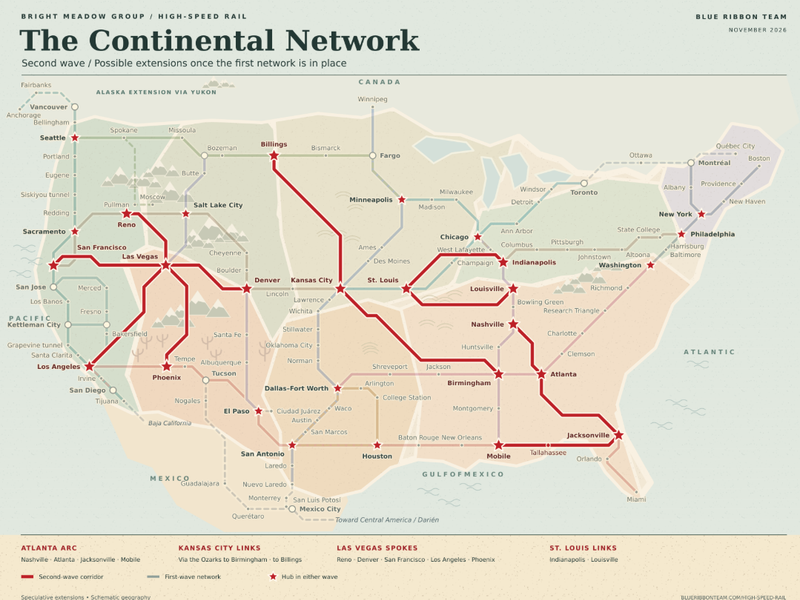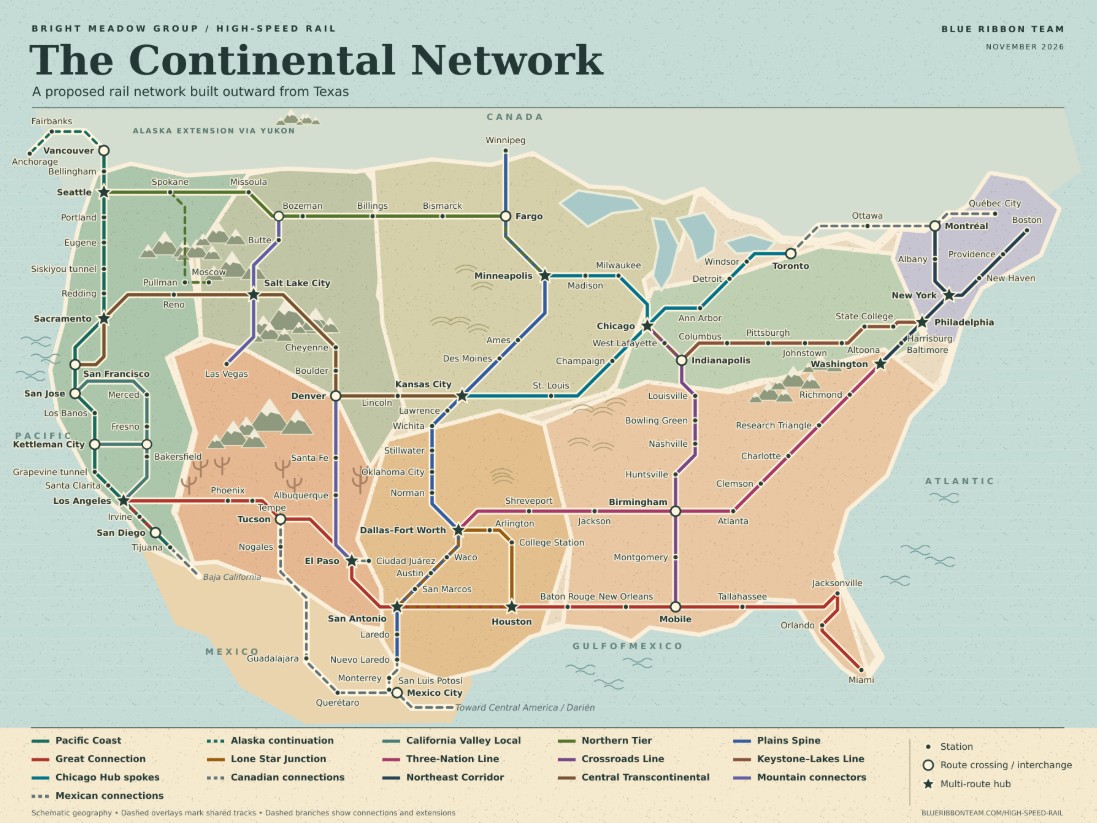
A Bright Meadow Group summary of the high-speed rail series: one map, one hemisphere, built outward from Texas
Over this series we’ve drawn a high-speed rail network line by line. The Lone Star Junction put a pin in Texas and called it the knot in the continent’s bow tie. The Continental Spine drew the strings. The pieces since then have walked each line, city by city, and refined the order of the build. This piece puts the whole map back together in one place.
The goal hasn’t changed. Connect the cities and the universities. Make brains mobile. Put the minds of a continent within reach of each other and let industry find a way to use what they build. Along the way, give the country something it has lacked: a way for people to move between its regions as easily as a phone call moves between them.
OBSERVE
The country has done this twice before. In 1862, in the middle of the Civil War, Congress passed the Pacific Railway Act, and seven years later the first transcontinental railroad tied the two coasts together. A nation that had always been huge, isolated and diverse became a nation that could reach across its own continent, with ports on two oceans able to support each other. In 1956 Congress passed the Interstate Highway Act, drew a national road map in one stroke, paid the bulk of the bill, set federal standards, and let the states build. Both models sit on the shelf, ready to be pulled down and pointed at high-speed rail.
The corridors exist. The railroads surveyed and graded them more than a century ago, and many still run straight and flat across the Plains and the Gulf Coast. The interstates added a second set of corridors with wide medians. Between the two, a national network can follow lines already laid out and already owned.
The legal tools exist too. Congress folded the bankrupt Northeastern railroads into Conrail in the 1970s. Amtrak holds a federal power to ask the Surface Transportation Board for rail property it needs for passenger service. And the freight map is consolidating: Union Pacific is asking the Board to approve its absorption of Norfolk Southern, which would create the first coast-to-coast freight railroad. A handful of private owners hold the corridors the country needs, and one of them is asking Washington for permission to get bigger.
The pieces are scattered. Amtrak’s new Acela trains run the Northeast Corridor, but they reach top speed on only about 40 miles of a 453-mile trip, and Boston to Washington still takes close to seven hours. Brightline runs in Florida. California is building its high-speed line. Illinois runs 110 mph service to St. Louis. Mexico is laying track toward Nuevo Laredo, and Canada is planning a high-speed line from Toronto through Ottawa and Montreal to Quebec City. The country has a pile of quilt squares and no quilt.
DESIGN
The alignment rules. Every line in the series follows the same four rules, in order. Interstate medians where the highway runs straight and flat. A dedicated track pair beside existing freight lines, because a 200 mph train can’t share rails with a mile-long coal drag. Federal reclamation of the right-of-way where an owner won’t share. New alignment only for mountain crossings and city entries.
The three islands. The network starts as three islands built in parallel, each growing toward the others.
Texas comes first. The triangle is the international hub, facing Mexico and the hemisphere, and it has to be born. Nothing there yet does the job.
The West Coast comes second. Its ports, airports and California’s line already under construction give it a critical mass of traffic waiting for the trains.
The Northeast Corridor comes third. It holds one of the largest concentrations of wealth and power on any coastline in the world, and it had a head start on the rest of the world in the 1960s. It wasted it. It builds in parallel, third in line for money, and stays an island until it joins the network in phase four or five.
The lines.
The Lone Star Junction. The Texas triangle of San Antonio, Austin, Dallas-Fort Worth and Houston, with the link south through Laredo into Mexico. The knot that the rest of the network ties into. [link]
The Plains Spine. Laredo – San Antonio – Austin – Dallas-Fort Worth – Oklahoma City – Wichita – Kansas City – Des Moines – Minneapolis – Winnipeg. The north–south backbone of the network and of the hemisphere. It runs from the Mexican gate to the Canadian prairies, and the other trunks branch off it like ribs. [link]
The Great Connection. Miami to Los Angeles and San Diego along I-10 and the Sunset Route, by way of New Orleans, Mobile, Houston, San Antonio, El Paso, Tucson and Phoenix. The easiest line to build, flat across the Gulf Coast and the desert, and the line that mixes the country’s cultures: Cuban Miami, the Deep South, Creole and Cajun Louisiana, Tejano Texas, the border, the Native Southwest. San Antonio sits at its center, the city where the border meets both coasts. [link]
The Three-Nation Line. Washington to Dallas-Fort Worth through Richmond, the Research Triangle, Charlotte, Atlanta, Birmingham and Jackson, along the Piedmont below the Smokies. It ties the wealth and power of the East Coast to the international hub and connects the inland South. Opened together with the line from New York to Montreal, it puts Mexico, the United States and Canada on one network. [link]
The Chicago Hub. Spokes from Chicago to Kansas City, Minneapolis and Detroit, plus the Keystone-Lakes Line from Philadelphia through Johnstown and Pittsburgh to Chicago and the Crossroads Line from Chicago through Indianapolis, Louisville, Nashville and Birmingham to Mobile. The whole middle of the country joins the international network here, with gates to Mexico through Kansas City, to Canada through Winnipeg and Toronto, and a third approach to Washington from the west. [link]
The Central Transcontinental. Kansas City to the Bay Area through Lincoln, Denver, Cheyenne, Salt Lake City, Reno and Sacramento, along the route of the first transcontinental railroad. It finishes the West’s three crossings alongside the Northern Tier from Minneapolis to Seattle and The Great Connection along the border. The Front Range Connector from El Paso to Denver and the Salt Lake connectors north to Butte and south to Las Vegas carry high-speed rail to the West’s smaller cities. [link]
The Pacific Coast. Tijuana to Anchorage as a corridor, with Los Angeles to San Francisco as its first leg, built on two lanes of I-5. Commuters move to the train and free the highway lanes for freight from the ports. [link]
The Head Start. The Northeast Corridor from Washington to Boston, with the spur from New York to Montreal. Rebuilt to an hour rule, with no two stops more than an hour apart and a dedicated track pair for the fast trains. [link]
The junction cities. Certain cities wake up one day connected to everything. San Antonio, where the border meets both coasts. Dallas-Fort Worth, where the Plains Spine meets the Three-Nation Line. Kansas City, the center of the continent, where the Spine meets the Central Transcon and the Chicago spoke. Minneapolis, where the Spine meets the Northern Tier, the second Chicago spoke and the road to Winnipeg. Chicago, the hub of the middle. Birmingham, where the Crossroads Line crosses the Three-Nation Line. Mobile, where the Crossroads Line meets the Gulf. Salt Lake City, the junction of the mountain West. Washington, approached from three directions, each leading to a different border.
The gates. Four to Mexico: Laredo, El Paso, Nogales and San Diego. Four to Canada: Vancouver, Winnipeg, Toronto and Montreal. South of Mexico, the long corridor runs through Central America to the Darién, as The Lone Star Junction laid out. Mexico City and Winnipeg sit on one line.
The campuses. The trunks thread through flagship universities and research schools from UT Austin to MIT, from Purdue to Berkeley. A researcher in Austin sits in on a seminar in Lawrence and is home for dinner. A robotics lab at Carnegie Mellon and an engineering lab at Purdue sit a morning’s ride apart. Huntsville’s rocket country shares a track with the Midwest’s engineering schools. The campuses stop being islands.
The people. Labor moves to the work without moving the family. A welder in Johnstown takes the job in Indianapolis and comes home on weekends. A family in Baton Rouge rides to San Antonio for Fiesta. A nurse from Winnipeg works a contract in Minneapolis. A student at the University of Wyoming spends a weekend in Denver. The middle of the country stops being the stretch people fly over and becomes the stretch they ride through.
INTERVENE
This is a federal project, and the playbook runs through Washington.
- Pass a National High-Speed Rail Act. Create a federal authority with the national map, the money and the power to acquire right-of-way, using the 1956 highway act as the template. States become construction partners.
- Reclaim the corridors for public use. Expand the existing federal power to acquire rail property for passenger service. Freight carriers keep operating rights on shared corridors, so the goods still move while the public regains the ground under them.
- Reserve the medians. The interstates were built with federal money. A federal rule can reserve their center lines for rail: I-35, I-10, I-20, I-85, I-80 and the rest.
- Put conditions on the merger. The Union Pacific–Norfolk Southern review is a federal proceeding. Passenger access to the Sunset Route, the Overland Route and the Norfolk Southern main line through the Piedmont belongs on the list of conditions for approval.
- Open the border tables. Binational agreements with Mexico and Canada for the gates, customs stations, shared standards and through-ticketing from Mexico City to Ottawa, with Central America on the agenda.
- Build to one standard. Gauge, power, signals and trainsets match from the first day, so when the islands meet, they connect like plugs into sockets.
- Build in sequence, and let the ribbon cuttings land when they land.
Phase one: The three islands, in parallel. The Texas triangle with the Laredo link to Mexico. The Pacific Coast’s first leg from Los Angeles to San Francisco. The Northeast Corridor rebuild, third in line for money.
Phase two: The Plains Spine from San Antonio to Kansas City.
Phase three: The Chicago spokes, starting with Kansas City to Chicago.
Phase four and beyond: Once the corridor from San Antonio to Kansas City shows its growth, the financing lines up behind a proven model and the remaining trunks build at once. The Three-Nation Line and the New York–Montreal spur open together for the triple connection. The Northeast Corridor joins the network. The Great Connection, the Central Transcon, the Northern Tier and the western connectors fill in the map.
The early phases do the convincing. A working spine from the border to Kansas City, full of students, researchers and business travelers, makes the case better than any study. After that, the rest of the country will want its line, the way towns lined up to get on the interstate once they saw what it did for the towns already on it.
Sources
Blue Ribbon Team, The Lone Star Junction: https://blueribbonteam.com/blog/2026/10/20/the-lone-star-junction/
Blue Ribbon Team, The Continental Spine: https://blueribbonteam.com/blog/2026/10/21/the-continental-spine/
Blue Ribbon Team, The Keystone Network: https://blueribbonteam.com/blog/2026/01/14/the-keystone-network/
Blue Ribbon Team, The Plains Spine: https://blueribbonteam.com/blog/2026/11/19/the-plains-spine/
Blue Ribbon Team, The Great Connection: https://blueribbonteam.com/blog/2026/11/11/the-great-connection/
Blue Ribbon Team, The Three-Nation Line: https://blueribbonteam.com/blog/2026/11/14/the-three-nation-line/
Blue Ribbon Team, The Chicago Hub: https://blueribbonteam.com/blog/2026/11/16/the-chicago-hub/
Blue Ribbon Team, The Central Transcontinental: https://blueribbonteam.com/blog/2026/11/20/the-central-transcontinental/
Blue Ribbon Team, The Pacific Coast: [link]
Blue Ribbon Team, The Head Start: https://blueribbonteam.com/blog/2026/11/09/the-head-start/
Blue Ribbon Team, Two Lanes to Anchorage: https://blueribbonteam.com/blog/2026/11/05/two-lanes-to-anchorage/
Blue Ribbon Team, Second Shift: https://blueribbonteam.com/blog/2026/11/07/second-shift/
CT Examiner, Amtrak’s Next Gen Acela — Just Hype?: https://ctexaminer.com/2025/08/27/amtraks-next-gen-acela-just-hype/
Railmarket, STB accepts Union Pacific–Norfolk Southern merger application: https://railmarket.com/news/business/57579-us-surface-transportation-board-accepts-union-pacific-norfolk-southern-merger-application
Surface Transportation Board, UP–NS environmental review, Docket FD 36873: https://www.stb.gov/upns-eis-fd36873/