A Follow-Up to Ship to Shore Data
An open concept paper from Bright Meadow Group
In July we published Ship to Shore Data, which argued that the Navy is retiring a data center fleet without recognizing it as one, and its companion piece Data Center Cooling Design, which laid out the thermodynamics underneath it. Both were assembled from public sources: decommissioning notices, the FY2023 disposal list, Nautilus Data Technologies’ published operating figures from the Port of Stockton, the St. Lawrence Seaway lock dimensions, and the plain arithmetic of rejecting heat into water instead of air. There was no inside line to a shipyard, a hyperscaler, or a program office. The pieces were sitting on the table face up, and it seemed worth an afternoon to turn a few of them over and see whether the edges matched.
They did. On August 3rd, Samsung Heavy Industries signed an engineering contract with Mousterian Corporation to design purpose-built floating data centers at 50 megawatts of IT capacity each, for deployment in Texas with commercial operation targeted for the second quarter of 2028. Guy Massey’s newsletter, 105: Data Centres Setting Sail, lays out the full sequence behind that signature — Approval in Principle from both ABS and Lloyd’s Register in April, a three-way development agreement in June, then the design contract in August — and situates it against six other programs chasing the same water. It is the most thorough survey of the category anyone has published, and readers who want the engineering detail should start there rather than here.
What follows is the part of the picture that survey does not cover, which is where the platforms come from and who collects the revenue.
The field as it stands
Massey sorts the category into four engineering bets, and the taxonomy holds up well.
Moored barges are the near-term favorite. SHI’s design runs roughly 190 meters, carrying a data hall on deck alongside integrated LNG storage, with power available either by shore cable or from onboard fuel cells running about thirty days independent. Cooling combines seawater with the cold released when LNG regasifies, a trick carried over from the shipbuilding side of the house. The siting preference is sheltered water near existing industrial infrastructure.
Converted vessels are the fast-follower. Mitsui O.S.K. Lines is working two programs at once, one with Kinetics at 20 to 73 megawatts using a repurposed car carrier, another with Hitachi converting used ships for Japan, Malaysia, and the United States. Both target 2027. The stated reason for looking abroad is that Japanese land, permitting, and environmental costs make domestic siting unattractive.
Fixed underwater installation is China’s approach. The Lingang facility sits about ten kilometers off Shanghai, backed by roughly $230 million in state investment, scaling from a 2.3-megawatt pilot toward 24 megawatts through this year. Power arrives from offshore wind down the same cable that carries the data, which is an elegant piece of consolidation.
Wind-integrated platforms and autonomous ocean nodes round out the field. Aikido Technologies is building compute halls into the legs of a floating turbine platform, with a proof-of-concept going into the North Sea at Norway’s METCentre by year’s end. Panthalassa has raised $210 million to put mostly submerged wave-powered nodes in open ocean, connected to shore by satellite rather than cable.
Underneath all of it sits the demand curve. The IEA put global data center electricity use at about 415 terawatt-hours in 2024 and projects roughly 945 by 2030. Grid interconnection queues in US markets average four years. Available inventory across the Americas is under three percent. Fewer than one in ten existing US facilities can handle current AI hardware, because the industry spent two decades building for racks drawing six to fifteen kilowatts and the training clusters now want forty to a hundred and twenty.
That last figure is the July argument arriving from the other direction. Stockton supports rack densities up to 100 kW against the 5 to 10 kW typical of land-based halls. The constraint on the buildout is not capital and it is not demand. It is that the buildings are the wrong shape and the wires are not there.
Where this confirms the July argument
Three claims now carry industrial signatures.
Water cooling at hyperscale efficiency is settled. Every serious program in the field cites Stockton. Massey uses it as the established baseline for the entire category. What we described as the proof of concept, the industry now treats as the floor.
Sheltered water beats open ocean for a first unit. SHI is choosing calm water near industrial sites. Nautilus sits in a river. The cold water doctrine’s third variable — depth, and the reliability that comes with intake below the thermocline — is the same instinct SHI is expressing as a siting preference, and two classification societies have now blessed it.
Conversion beats new construction on schedule. Mousterian’s own explanation is that shipyard fabrication advances in parallel with sitework rather than after it. That is the argument for the well deck and the engine room, made by a firm building from scratch and still finding the yard faster than the field.
The structures nobody in the survey mentioned
Here is a category absent from every taxonomy we have read, our own July version included.
The Gulf of Mexico holds well over a thousand fixed offshore platforms. A substantial share are idle, past production, or approaching lease end. Under the Idle Iron policy an operator carries an obligation to plug wells and remove structures on a schedule after a lease terminates, and that decommissioning liability runs into the billions across the basin. The Rigs-to-Reefs programs in Louisiana and Texas exist because leaving steel in the water, in the right configuration, has been judged better than hauling it out.
Consider what a fixed platform already is. A structure anchored to the seabed and engineered for hurricane loading, with deck space measured in thousands of square feet, crew quarters, a helideck, potable water production, its own power generation, fire suppression, a control room, and in many cases an existing pipeline and a communications drop. It is also, in the terms governing this entire conversation, an object that does not rock. The low-frequency motion problem Massey identifies as the largest open engineering question in the category is a problem a jacket platform does not have.
Two synergies suggest themselves, and both deserve engineering scrutiny rather than enthusiasm.
The first is wind. In the North Sea, repurposing platform structures and their seabed rights for offshore wind service has moved from proposal to practice. A platform inside or adjacent to a wind lease area, carrying compute on deck, becomes the same consolidation China built at Lingang: generation, cooling, and cable in one place, with the electricity never touching an interconnection queue. This is the deck-edge argument from the July piece at industrial scale — surface area the structure provides for free, improving the arithmetic.
The second is gas. Associated gas with no economical route to market currently gets flared, and running compute on stranded and flared gas is established practice onshore; Crusoe Energy built a business on that arithmetic. Whether the same arrangement is permissible offshore is jurisdictional rather than technical, and it is a real question. BSEE and BOEM authority governs use of the outer continental shelf, lease terms are written for hydrocarbon production rather than data processing, and repurposing a platform for a non-energy use meets a regulatory framework with no category for it. That deserves someone’s legal time. It also deserves noticing that the answer might come back yes for the same reason it came back yes for offshore wind, which is that Congress wrote a pathway when it decided one was needed.
We raise this without claiming to have worked it through. If someone in the offshore engineering world has run these numbers, we would like to read them.
But the better asset is already ours
Set the platforms aside, because that question sits downstream of a simpler one.
Every serious program in this field is spending money to acquire a structure. SHI is cutting new steel in Korea. MOL is shopping the second-hand commercial market. Panthalassa and Aikido are building from scratch. Rig conversion would mean negotiating with a lease operator holding a liability, who will price accordingly.
The American taxpayer already owns the best inventory available and is paying money to destroy it.
The July piece walked through what a Whidbey Island–class hull already contains: a well deck that is a covered, drainable interior volume engineered to keep sensitive cargo dry inches above open water; engine rooms with sea chests, raw-water intakes, pumps, and heat exchangers sized for main propulsion and rated for decades of marine duty; hardened generator rooms with bunkers measured in hundreds of thousands of gallons and fire suppression already certified for that hazard; roughly an acre of load-rated flat deck topside. Against a greenfield hyperscale build at $10 to $12 million per megawatt, most of it shell and cooling plant, the ship is the shell and the cooling plant. The complete Stockton facility listed at $45 million, and that barge had to be built.
Nothing in the last five weeks has changed those numbers. What changed is that the rest of the world started paying real money for worse versions of the same thing.
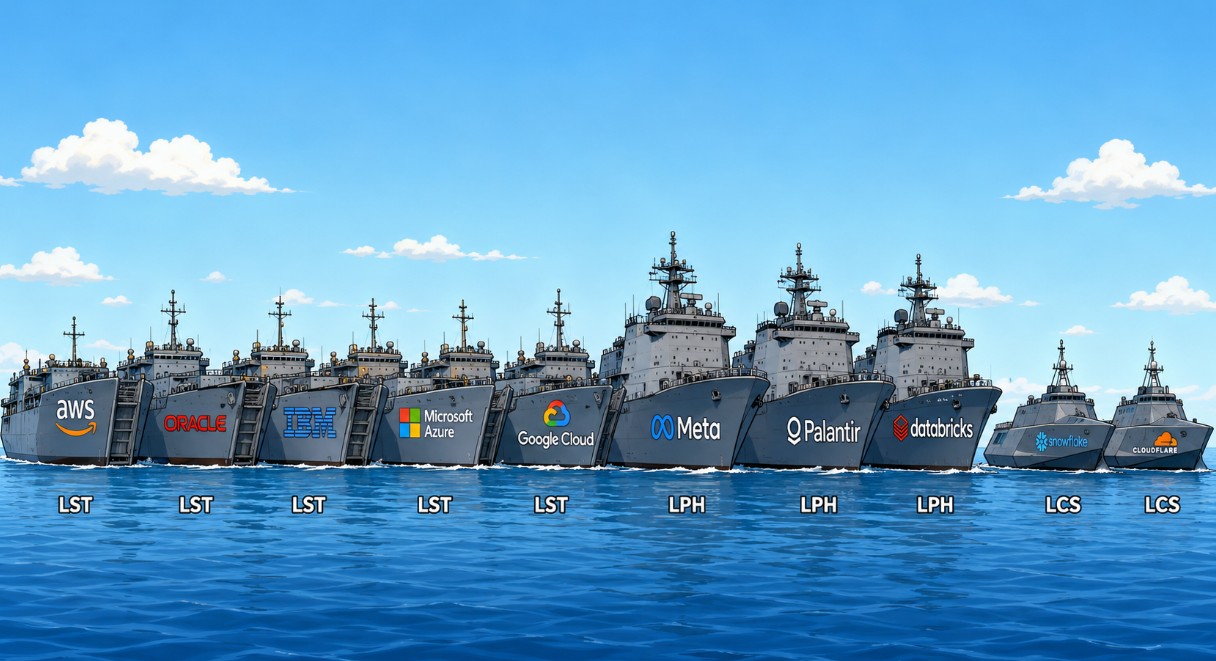
The gator freighters and helicopter carriers remain the right fleet for reasons the offshore programs make clearer by contrast. Fifteen to twenty-five thousand tons is working industrial scale rather than a small city. Beam and draft suit rivers and harbors rather than requiring deep water, which is where the vibration answer points. Disposal is entirely conventional, with no radiological handling and no specialty contractor, so a shipyard can start Monday. And the Freedom-class hulls carry a delivery precedent rather than a hypothesis, having been built at Marinette and taken to sea through the same 78-foot locks that will carry them back.
Disposal is not free even at the modest end of this fleet, and at the high end of the Navy’s list it becomes spectacular — the service will spend more than a billion dollars unmaking a single retired carrier. Every hull on the list carries some version of that bill.
The only comparable inventory on Earth is the retired cruise ship market, and the comparison instructs. A laid-up cruise ship has enormous hotel load capacity, generation, seawater systems, and berthing, and it is a genuine candidate for this work. It is also privately owned, foreign-flagged in most cases, and priced by people who know exactly what the breakers at Alang will pay. The SS United States spent thirty years rusting at a Philadelphia pier while a succession of owners failed to find her a use. That is what the private market does with a large hull it cannot monetize: it pays dockage until it can’t, then sells the steel.
Every attribute the private market has to buy, the public already holds. American-built, government-owned, moored in domestic water, carrying a disposal cost rather than a purchase price.
Three details from Massey’s reporting sharpen how much that matters.
The coastwise problem is one this fleet does not have. Massey flags shipping law as a live legal question for SHI, because the barges will be built in South Korea before entering US waters, and notes that a 2021 offshore wind ruling suggests a workable path with careful planning. Whether §55102 binds a moored platform carrying no merchandise is a question for counsel. The point is that it is a question at all, and an American-built hull already owned by the United States government never has to answer it.
Project Natick’s lesson favors a warship. Microsoft sealed 855 servers off Orkney and found them failing at roughly one-eighth the rate of an identical land batch, then shut the program in 2024 because a capsule you have to raise from the seabed cannot keep pace with a two-year hardware refresh. Massey’s conclusion is that maintenance access now governs the category. A gray hull is a machine built around the premise that a sailor will need to reach every space in it at three in the morning with the ship underway. Passageways, hatches, deck cranes, ventilation trunks, and the marine trades to work on them all exist before the first rack ships.
The vibration question points inland. Massey calls slow, continuous wave motion the largest unanswered engineering problem in the field, and notes that nobody has run the long test. Server hardware is qualified against sudden shock rather than against being rocked gently for years. If that motion is what strands the offshore designs, then Duluth, Bremerton, and the Ohio pool stop reading as modest ambitions. The cold water doctrine — intake temperature, exchange rate, intake depth — was published as a scoring metric any port authority could apply to itself. It now also scores the thing the offshore programs cannot fix by choosing a better mooring.
The objection we did not raise in July
The July piece stood four objections up and answered them: hull condition, thermal discharge, transfer pathway, and winter. A fifth belongs on that watch bill now.
Approval in Principle from ABS and Lloyd’s Register is what made the SHI program credible to investors. It is the event that separated this category from a decade of conference renderings. No equivalent pathway exists for a naval hull entering commercial service. Federal disposal law defaults to scrapping, target sinking, and foreign sale, and a conversion pathway takes MARAD program action or a line in an authorization bill — that much we said in July. What we did not say is that the transfer authority is only half the instrument. The other half is a classification standard that lets a converted gray hull carry cargo insurance, satisfy a lender, and sign a lease with a customer who answers to a board.
That is legislative and regulatory work, it will take longer than anyone wants, and it should start before a hull worth having has already been cut up.
To the administration, plainly
This is a policy opportunity sitting in the open, and it addresses several problems at once.
The compute buildout is stalled on power and land. Four-year interconnection queues and sub-three-percent vacancy are the binding constraints on domestic AI capacity. A moored hull with organic backup generation and a river for a heat sink bypasses both. Stockton’s barge needed roughly 48 hours pierside to connect and come online. Capacity that would otherwise wait until 2030 for a substation can be in service inside a normal shipyard availability.
The disposal list is a liability that could be an asset. Scrapping a fifteen-year-old warship costs money and returns the price of steel. Transferring that hull into a conversion program eliminates the disposal expense and creates a revenue-generating public asset in its place. The accounting change alone is worth a hearing.
The shipyard trades need work. Conversion is the kind of sustained, skilled, unglamorous availability work that keeps welders, pipefitters, electricians, and marine engineers employed between new-construction contracts. Kitsap County alone discharges those trades into the labor market every year within sight of the pier where the hulls are already moored.
Compute on sovereign hulls is a national security posture. The alternative taking shape is domestic AI capacity built on foreign-fabricated platforms financed by foreign capital and, in China’s case, built by the state as declared national strategy. A federally owned floating compute fleet is a different answer to that competition than a subsidy.
And the revenue can come home. The hulls are public property. The disposal cost is public expense. The water is held in public trust, and the authority over intake and discharge is public authority. When the steel, the mooring, the thermal resource, and the disposal liability all start out public, letting the lease revenue flow to private equity is a choice rather than a necessity. Public hull, public water, public power, public revenue — the Data Center Dividend in its most concrete available form, on the Alaska Permanent Fund pattern, at a scale a port authority or a bi-state compact can actually finance.
None of this requires a new technology. Nautilus proved the thermodynamics five years ago and Samsung is now building against it. What it requires is a transfer authority, a classification pathway, a lease template, and someone with standing to put the Navy, MARAD, the classification societies, and a buyer in the same room.
BIS Research values the global floating data center market at a bit over $200 million today, growing toward $730 million by 2033. Those figures assume the category stays private and coastal. They do not contemplate a national government contributing several dozen hulls it is already paying to have destroyed.
What we are watching
Whether anyone publishes long-duration vibration data, and whether the results push the category toward sheltered and inland water.
Whether a US legal opinion settles the coastwise question for moored platforms, and whether that settlement favors domestic hulls or clears the path for imported ones.
Whether ABS or Lloyd’s Register begins work on a classification standard for compute equipment at sea, and whether it makes any provision for converted government tonnage.
Whether anyone in the offshore sector takes the platform question seriously enough to publish numbers.
Whether a single member of Congress, from a state with a reserve basin or a shipyard, asks what the Navy’s disposal list is worth as an asset rather than as a line item.
The fleet is retiring either way. Score the water, pick the pier, and plug it in.
Bright Meadow Group publishes its concept work under an open framework. This document may be reproduced, adapted, and built upon without permission or fee. If you are working on any part of it and want to compare notes, the door is open.