Mr. Wright on tax brackets, write-offs, and why the same labor fights keep coming back around.
I sat down this week meaning to write about one strike. Ended up reading about a dozen.
Hospital staff fighting over staffing. Steelworkers fighting over pensions. Hotel housekeepers, warehouse crews, truck drivers, a coffee shop crew somewhere trying to win a first contract. Doctors, too. Folks with good salaries finding out a good salary doesn’t buy you a say in how the floor runs.
Then I pulled some labor history off the shelf, and there were the same fights in older hats. Wages. Hours. Safety. Who gets to bargain and who gets told to be grateful.
My father carried bags on the railroad for thirty years. He had a saying about plumbing: a man who keeps patching the same leak ought to take a look at the pipe.
So this one’s about the pipe.
A contract settles one shop. It can win a raise, a staffing ratio, a grievance procedure. It can’t touch the rules that decide how much money piles up at the top before anybody sits down at the table. Those rules get written somewhere else, and one of the places they get written is the tax code.
The old rulebook
Prior to and during Dwight Eisenhower’s two terms, the top federal income tax rate on individuals was 91 percent. The top corporate rate was 52 percent. Today the same two rates sit at 37 and 21.
Now, let’s measure that straight, because this is where folks on both sides start selling you something.
That 91 percent was a marginal rate. It worked like an overtime bracket running in reverse. It touched only the dollars earned above a very high line, and in the 1950s that line sat around $200,000 for a single filer. On top of that, deductions and special treatment for investment income meant the wealthy paid well under 91 percent overall. Anybody who waves that number around without telling you so is short-weighting you.
Here’s what the rate did do. It changed the value of the next dollar.
Say an executive is angling for an extra million in salary, sitting above that top tax line. At 91 percent, he takes home $90,000 of that million dollar bonus. At 37 percent, he takes home $630,000. Ask yourself how hard a man fights for a raise that nets him ninety grand versus one that nets him six hundred and thirty.
Economists Thomas Piketty, Emmanuel Saez and Stefanie Stantcheva looked at this. They found that when top rates came down, executives bargained harder for bigger pay packages and more of the country’s income collected at the very top, without the faster growth that was supposed to come with it.
The write-off is the carrot
This is the half of the story folks skip.
A business pays tax on profit, and profit is what’s left after expenses. Wages come off the top. So does training. So does a good share of research. Machinery and buildings come off too, spread out over the years they’re in service. Money spent running and building the shop reduces the tax bill.
The higher the rate, the more that deduction is worth. A profitable company facing a 52 percent rate that spends $100,000 on qualifying expenses knocks $52,000 off its federal tax. At 21 percent, the same spending saves $21,000.
Picture an owner coming off a good year. Under the old rulebook, if he pulls the money out and takes it home, the government takes the lion’s share of whatever lands above that top line. If he puts it back into the operation, a new press, a raise for the crew, an apprentice program, a big piece of the cost comes back to him off the tax bill.
The rules made the shop floor the better deal.
Under today’s rates the gap between those two choices is a lot narrower. Taking money out through big payouts and stock buybacks looks a lot more attractive by comparison.
I’ll give you the other side of the ledger too, because a steward who only reads management’s mistakes isn’t doing his job. A high rate by itself guarantees nothing. Companies can sit on cash. Rich folks can take their money as investment gains instead of salary. Write-offs can reward spending that builds nothing useful. How the deductions are designed matters as much as the number on the top bracket.
Measure twice. Then build.
The tax money goes to work too
Now go to the other end of the pipe. The money that does get collected has to go somewhere.
In 1956, Eisenhower signed the Federal-Aid Highway Act. It authorized $25 billion over thirteen years for 41,000 miles of interstate. To be straight with you, that system was paid for mainly through gasoline and highway-user taxes, not the top income bracket. It also tore through a lot of neighborhoods and left some towns stranded off the exit ramps.
But it shows what public money can do. It gave a trucking outfit with three rigs the same road the big carriers drove on. It let a worker reach a job forty miles away.
Think about a welder who wants to open her own fabrication shop. She knows the trade. She’s got customers asking. What she doesn’t have is family money or a banker who returns her calls.
She needs a road her trucks can use. Reliable power. Trained hands she can hire. A loan she can qualify for. Childcare, if she’s got kids. Health coverage she won’t lose the day she quits her job, so starting a business doesn’t mean gambling her children’s medicine.
Each of those is something public investment can put within reach. That’s growth from the bottom rung. The old rulebook moderated the pile at the top and used what it collected to build more rungs.
Why a steward cares about competition
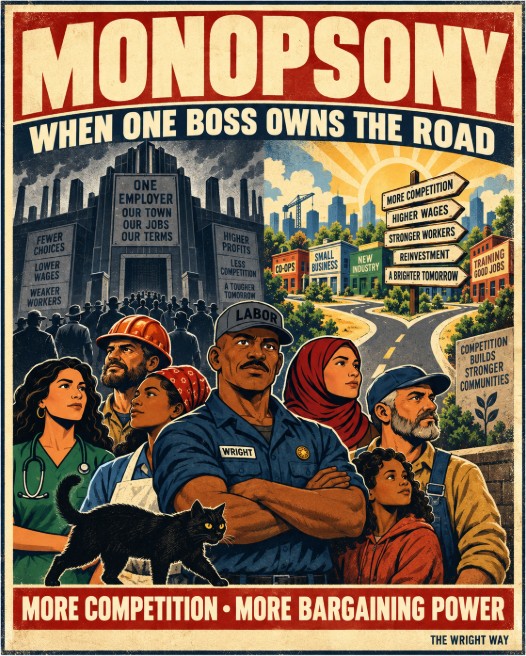
There’s a word economists use, monopsony. It means a buyer with too much power, and in this case the buyer is the one buying your labor.
When a town has five employers in a trade, a man with a good record can walk across the road and hire on somewhere else. That walk is bargaining power, and the boss knows it. When one outfit buys up the other four, walking across the road gets you the same boss with a different sign on the gate.
A 2024 review in the Annual Review of Economics laid it out: when employers don’t have to compete for workers, wages get held down. The authors pointed to merger enforcement and fewer barriers to changing jobs as ways to fix it.
Taxes and antitrust do different jobs. The 1950s had a 52 percent corporate rate and still had giants, so the government used other tools too. A 1956 settlement made AT&T license around 9,000 of its patents to other companies. Tax policy can tilt the field in other ways as well. A study published this August found that after the 1986 corporate tax cut, profitable airlines gained ground on struggling rivals, and some of the weaker ones left the market.
Here’s how it fits together. A company can grow by making a better product, training a better crew and serving more customers. Or it can grow by buying up everybody who might compete with it. The old rulebook leaned toward the first kind. It made hoarding expensive and reinvesting cheap, and it spent the difference on the ground new competitors need to stand on.
That’s good for capitalism, because a challenger can get into the game. It’s good for labor, because a worker has somewhere else to go. Same principle, both sides of the table.
Respect is the first safety rule, and a fair market is a kind of respect. It says you have to earn the next customer and the next worker.
Checking the measure
I won’t tell you the tax code built the 1950s by itself. It didn’t.
Unions represented roughly a third of the workforce then. American factories were standing when much of the industrial world had been bombed flat. And the prosperity folks get nostalgic about had a gate on it. Black workers, women and plenty of others were kept out of the good jobs and the good neighborhoods. My father’s generation doesn’t need a history book to remember that.
The Congressional Research Service went looking for proof that cutting top tax rates since the war produced faster growth. It didn’t find conclusive evidence. It did find that the cuts went along with more income concentrated at the top.
So here’s what the record shows. Very high top rates and a growing capitalist economy existed side by side for years. That doesn’t mean we copy 1955 bracket for bracket. It means the design of the rules matters, and we’ve got evidence about which designs keep money moving.
Back to the picket line
Every dispute I read about this week deserves to be judged on its own merits. The nurse arguing about patient ratios isn’t bargaining the same contract as the steelworker worried about his pension. Management has real costs, and labor owes a fair day’s work for a fair day’s pay.
But under both of those tables sits the same set of rules. They decide how much money floats to the top before bargaining starts, and how many doors a worker has when it’s over.
A tax code that makes extraction expensive and reinvestment cheap. Public money spent building the bottom rungs. Competition law that keeps challengers in the game. Put those together and you’re working on the pipe instead of patching the same leak for another hundred years.
The money has to go somewhere. Better it goes back into the shop and out into the street than up the chimney.
Now you know, Jack.