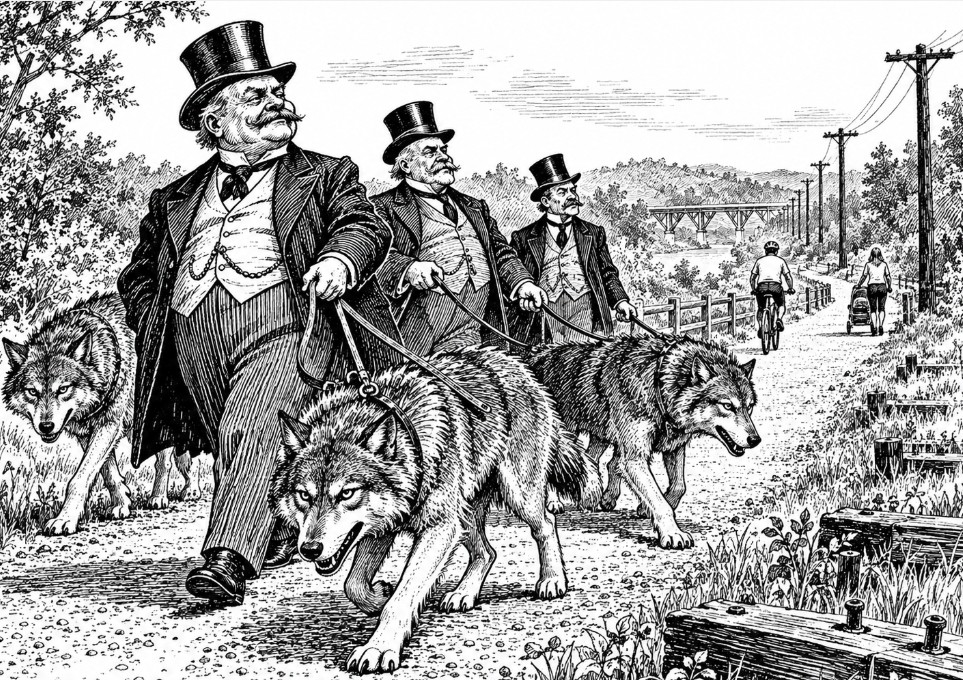
Across the country, old rail lines are turning into trails. The ties come up, crushed stone goes down, and a corridor that once carried coal hoppers now carries strollers, road bikes, and the occasional guy on a recumbent trike. Many of these trails ban motor traffic entirely, which makes them some of the calmest ground left in a lot of towns. I like them. I walk them, ride past them, and photograph what grows along their edges.
While I was writing The Span, I started looking at how these conversions happen, and the picture shifted. The trail reads as a gift to the public. Follow the money and the paperwork, and it reads more like a moat around the railroad’s holdings.
The stack
The layers pile up like this.
First, salvage. Rail steel and ties have scrap and resale value, and pulling them up recovers real money. In a lot of these deals, I’d bet the local municipality ends up covering removal or site work as its share of getting the “free” park.
Second, the donation. Handing corridor land or rights to a public body or trail nonprofit can count as a charitable contribution. That means a tax deduction on land the railroad had already stopped using.
Third, the land itself. Railroads assembled these corridors through federal land grants in the West and through state-granted eminent domain in the East. That was land taken from farmers and townspeople on the promise that a train would run through. When the train stops running, the promise ends. The ownership often continues.
Fourth, the crossings. Railroads hold crossing rights over and under their corridors, so anyone running fiber, water, or power across a line has to negotiate with them. Rural broadband projects can stall for months waiting on crossing permits and fees. A line with no trains on it still sits across a county like a locked gate across a road.
Fifth, federal law ties the rest together. Since 1983, the National Trails System Act has allowed “railbanking”: a line converted to a trail is treated as banked for possible future rail service instead of abandoned. Abandonment would often send the land back to the neighbors along the line, since many corridors were easements, with the underlying ground still belonging to the landowner. Railbanking stops that reversion. The trail keeps the corridor legally intact, and the railroad keeps its right to bring trains back someday.
So the park has a job. It holds the corridor together so it can’t dissolve back into the landowners and public it came from.
Truthfully, as a profit stack, it’s impressive: salvage revenue, a tax break, retained land, retained leverage over utilities that need to cross, and good press for donating a park. I envy the wealth it builds and protects. It still has to stop.
Who’s already paying
Landowners along banked corridors have sued, arguing the land should have reverted to them. In 2014, the Supreme Court sided with a Wyoming landowner in Marvin M. Brandt Revocable Trust v. United States. The Court held that on certain federal land-grant corridors, the government kept no interest once the railroad walked away. Takings claims over railbanked corridors have been paid out of the federal treasury since.
The public pays on more than one end. It funds the park, absorbs the tax deduction, and compensates neighbors whose land was held past its expiration date.
None of this gets sorted until somebody sues. A corridor is a patchwork: one stretch granted, another bought, another condemned. Right now the patchwork only gets untangled parcel by parcel, by whoever can afford a lawyer.
A board built for the job
Keep the parks. Let the railroads recover their steel and ties, at their own expense. Then send the rest through a review built for this purpose.
Congress could create a Rail Corridor Review Board with one mandate: when a line stops carrying trains, sort out who owns what before anything else gets built on top of it. The review would trigger automatically when a line is banked, converted, or left idle past a set period. No lawsuit would be required, and a landowner wouldn’t need to know the law to be protected by it.
The board would sort each parcel by how the railroad got it:
- Easement parcels revert to the adjacent owners, as the original deals intended.
- Land from public grants, or taken by eminent domain for rail service, returns to the public. There it can stay a trail, become a utility corridor, or both.
- Land the railroad bought outright stays with the railroad, or gets purchased at fair value if the trail needs it.
- Crossing agreements go through the same review. Where a parcel leaves railroad control, the crossing rights leave with it.
The Surface Transportation Board already handles rail abandonments, but its charge is keeping the rail network running. Returning title to neighbors and the public is a different task, and it deserves a body designed around it.
The output is a map. Before the first bike rolls down a new trail, the public knows which ground is theirs, which belongs to the farmer next door, and which the railroad paid for fairly.
Enough
These corridors were cut through the country on the promise of service. People gave up land, sometimes willingly and sometimes under condemnation, because a railroad was going to connect them to the rest of the nation. Where that service has ended, the land and the leverage should come home. The railroad barons have made enough off of us.
Sources
- National Trails System Act, 16 U.S.C. § 1247(d) (railbanking provision, added 1983)
- Marvin M. Brandt Revocable Trust v. United States, 572 U.S. 93 (2014)
- Surface Transportation Board, rail abandonment and railbanking procedures
- “The Span,” Blue Ribbon Team, September 3, 2026