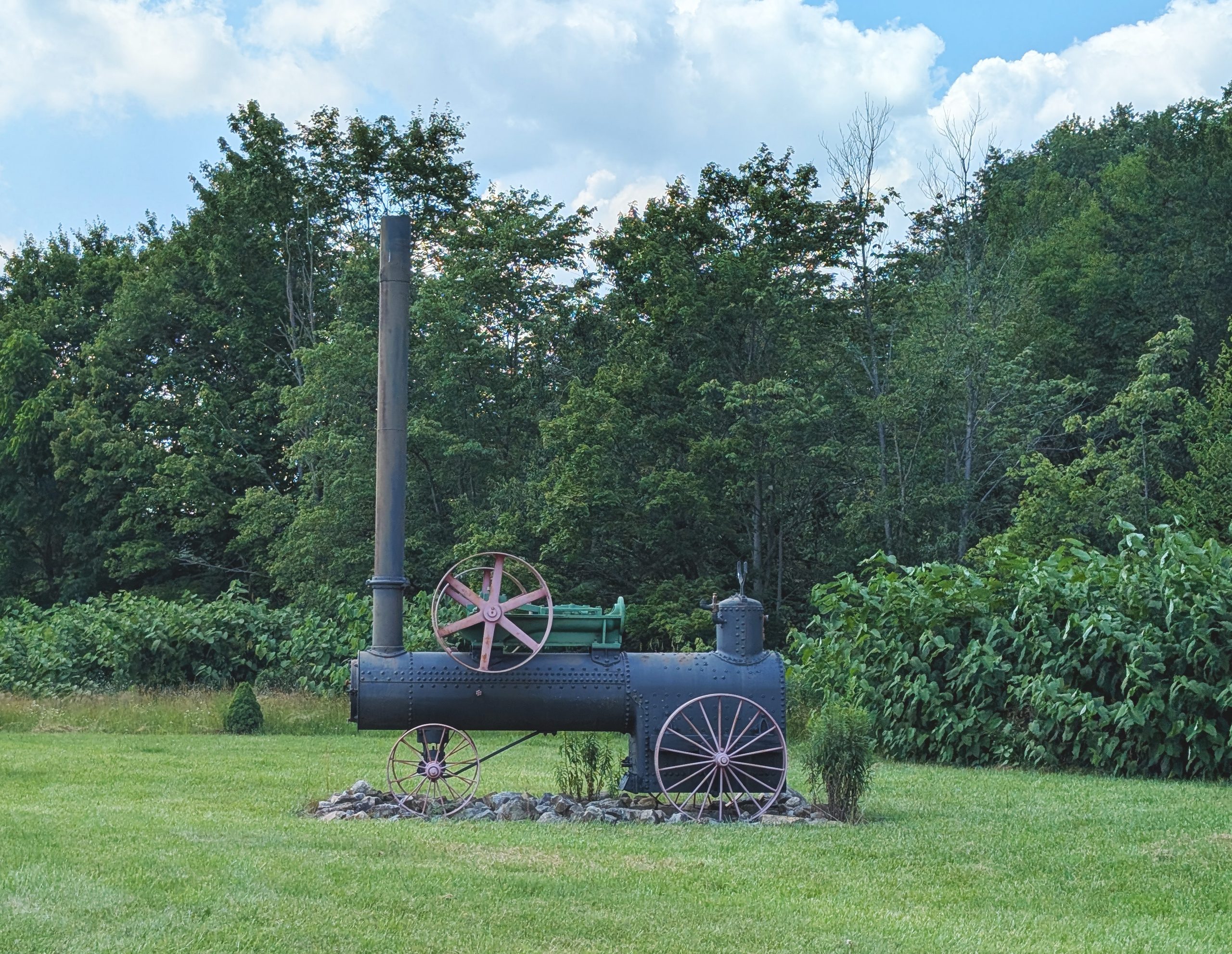
Before a steam engine could drive itself to the job, it had to be hauled there like a piano. That’s what sits in this lawn: a portable steam engine, the kind farmers and sawyers hitched to a team of horses and dragged from farm to farm and woodlot to woodlot through the back half of the 1800s. It rests now on a bed of fieldstone, fire long out, with the woods and a wall of knotweed crowding in behind it.
The machine reads left to right like a sentence. On the left, the tall stack rises off the smokebox, where spent gases and cinders gathered before heading skyward. The long barrel in the middle is the boiler, its seams stitched with rows of rivet heads like the quilting on an old leather jacket. Fire tubes ran the length of that barrel, carrying heat from the firebox toward the stack and turning the water around them to steam. The taller section on the right is the firebox, where a fireman fed wood or coal through the back door. Perched on top, the steam dome gathered the driest steam, and the fittings crowning it held the safety valve and whistle.
The engine itself rides piggyback. That green assembly bolted along the top of the boiler houses the cylinder, where steam shoved a piston back and forth to turn the crank, which spun the big red flywheel. The flywheel doubled as a belt pulley. Run a long flat leather belt from that wheel to a threshing machine, a buzz saw, a cider press or a grist mill, and you had a power plant you could park in a barnyard on Monday and haul to the neighbor’s on Tuesday.
The wheels give away how it traveled. They carry no gears, no chain, no drive linkage of any kind. They roll, and that’s their whole job. The small front pair under the smokebox took the hitch, with an iron brace running back beneath the boiler to tie the running gear together. The big rear wheels under the firebox carried the heavy end. Later machines, the traction engines, geared the crankshaft to the rear axle and walked themselves to the job. This one waited for the horses.
There’s a good joke in that arrangement. Before portable steam, a lot of threshing ran on horse power in the literal sense, with teams walking circles around a sweep or plodding up a tilted treadmill to turn the works. Steam took over the grinding labor, and the horses got reassigned to delivery. They towed their own replacement down the road and then stood around while it did the job they used to do.
For the steampunk crowd, this is the source material. Riveted plate, exposed motion, a flywheel the size of a wagon wheel, a stack taller than the man stoking it, and a paint scheme of black iron, barn red and machinery green that came straight off a nineteenth-century shop floor. Bolt a brass gauge cluster and a pair of goggles to it and you’d have a convention prop. Leave it be and you have the real thing, a machine that once smelled of coal smoke and hot oil and did a season’s worth of a county’s work, one farm at a time.