A Bright Meadow Group ODI reading of the Iron Age paired spoons
Somewhere around the third century BC, a bronzesmith in Britain made a pair of small spoons. He cast them, shaped the bowls shallow, and decorated the handles with the swirling curves of La Tène art. Then he did two odd things. Across the bowl of one spoon he scored a cross, splitting it into four quarters. In the other, near one edge, he punched a single small hole.
A couple dozen of these have turned up across Britain and Ireland, with a few on the continent, dating from the last centuries BC into the first century AD. They come in pairs, cross and hole, and they have sent scholars off in several directions. Victorian antiquarians called them baptismal spoons, which the dates rule out, since they predate Christianity in Britain by centuries. The favorite modern answer is divination: pour a liquid through the hole, see which quarter the drip lands in, read the omen.
We think the spoons are telling us something plainer. Anyone who has baked bread or filled a prescription has used a set like this.
Observe
- They’re bronze, palm-sized, with shallow bowls, too shallow for eating.
- They come as matched pairs, made to be used together.
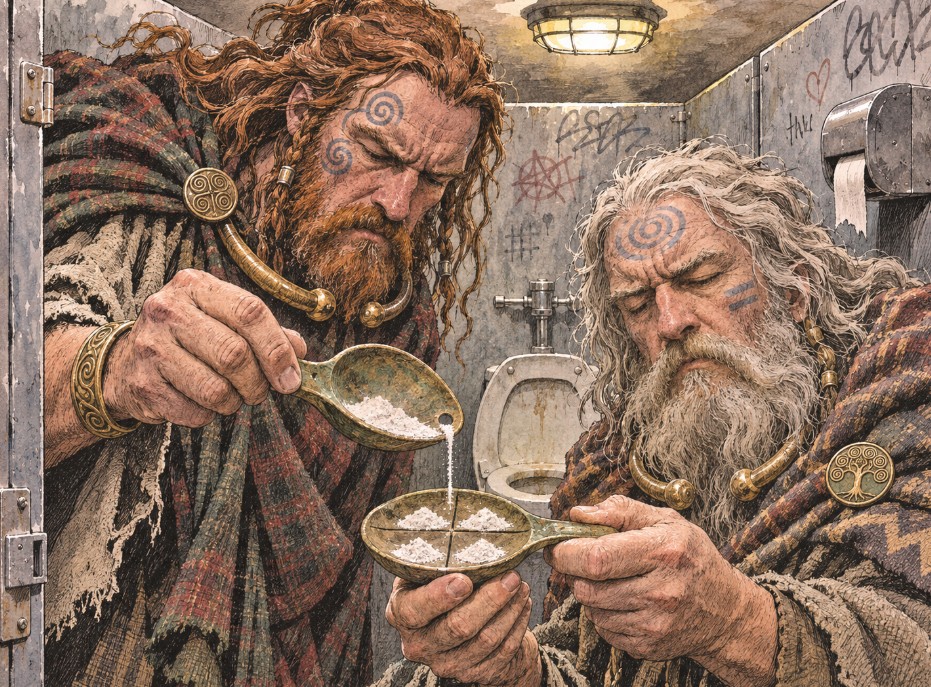
- One spoon in each pair carries an incised cross dividing the bowl into four equal parts.
- The other carries a small hole, set off-center near the edge.
- The handles are finely decorated, the work of a skilled smith for a client with means.
- Some were buried with the dead. Others went into rivers and bogs, where Iron Age people placed valued objects on purpose.
Design
Put the two spoons in your hands and the job shows itself.
The hole spoon pours. Fill the bowl, tip it, and the contents run out through the hole in a thin, steady stream you can start and stop with a turn of the wrist. A funnel does the same work, and so does the spout of an oil can. When the stuff you’re handling is precious, you want a narrow, controlled pour.
The cross spoon receives and divides. Those incised lines are shallow, and a shallow groove does a poor job of steering liquid, which pools wherever it likes. With a powder, the grooves become guide lines, like the score across a pill that tells you where to snap it. Pour your dose into the bowl, push the pile apart along the grooves, and you have four even shares. Anyone who has watched a man cut lines on a mirror will recognize the workflow.
So the pair is a pouring, measuring, and dividing set. The tool doesn’t care what goes through it, any more than a set of kitchen measuring spoons does. Ground herbs, a medicine, a spice traded from the continent, salt, a pigment, flux for a smith’s enamel work, gold dust, or something with a kick to it for a ceremony would all suit it.
The divination reading has a problem the measuring reading avoids. Several pairs appear to be made as left and right versions, as if for two hands working together. An oracle needs one operator dripping onto a target. A measuring set wants one hand pouring while the other holds the receiving bowl steady.
Intervene
The fine handles tell us the contents were worth a fine tool. Nobody commissions decorated bronze to portion out porridge. The burials tell us the owner held a role that followed him into the ground.
Iron Age Britain had a class of specialists suited to that role. Pliny the Elder describes the druids gathering medicinal plants with careful ceremony, cutting mistletoe with a golden sickle and collecting other herbs under strict rules. A healer-priest dosing remedies, a smith-alchemist measuring compounds, or a trader handling costly goods would each want a precise, durable, handsome measuring set, and would each have reason to be buried with it.
The river finds fit the same picture. A tool tied to a trade or an office might be retired with honor when its owner stepped down, the way a craftsman today might hang up his first set of tools instead of selling them.
The scored cross itself suggests the setting it served: dividing a dose fairly among four. Someone in the community held the job of making sure each person got an even cut, and he used the right tool for it.
The BMG question for a mystery object is what it did for the person holding it. Hand the paired spoons to a pharmacist, a cook, or a jeweler, and each will tell you within a minute. Measure, pour, divide.
Sources
- Pliny the Elder. Natural History, Books 16 and 24 (druids and the gathering of mistletoe and medicinal plants).
- Fox, Cyril. Pattern and Purpose: A Survey of Early Celtic Art in Britain. National Museum of Wales, 1958.
- Ashmolean Museum, Oxford: the Penbryn spoons (Iron Age paired spoons from Ceredigion, Wales).