Twenty-Five Years of Seeing It Firsthand
On Tuesday, the Centers for Medicare and Medicaid Services put out a press release announcing $35 million for rural Pennsylvania health care — screening technology, equipment to open more operating rooms, transportation so people can actually get to the building. Eleven Pennsylvania Republicans are quoted in it. One of them is ours.
“As someone who practiced medicine in rural communities for more than 25 years, I saw firsthand the challenges families face when care is out of reach.” -J Joyce
Twenty-five years. Firsthand. Hold onto that, because we’re going to need it.
The receipt
On July 3, 2025, the same man issued a statement celebrating his vote for H.R. 1. His office described the bill as legislation to secure the border, unleash energy production, prevent a tax hike, and — this is the part I want framed and hung in every waiting room in Bedford County — strengthen Medicaid. By rooting out waste, fraud and abuse, he said, the program would be strengthened so the most vulnerable Americans keep the benefits they need and deserve.
That was fourteen months ago. Here is what the Commonwealth says now.
Pennsylvania’s own Human Services Secretary, Val Arkoosh, puts the state’s Medicaid loss at $20 billion between 2028 and 2038 under that law. The Rural Health Transformation Program — the fund Tuesday’s $35 million comes out of — brings Pennsylvania about $193 million this fiscal year and maybe a little over a billion across five years.
Now, I’m going to do something the press release didn’t do, which is be honest about the arithmetic. Twenty billion and one billion are not the same ledger. Different programs, different decades, different mechanics. KFF has explicitly warned against slapping those two numbers next to each other, because most of the Medicaid cuts don’t even start until 2027 and they keep growing after the rural fund runs dry in 2030. So no, I will not run the cheap version of this story.
The honest version is worse.
The honest version is that the fund is temporary and the cuts are permanent. The fund expires in 2030. The cuts run to 2038 and beyond. We are being handed a five-year bridge over a ten-year canyon and told to admire the engineering. The state’s own budget secretary says plainly there is no backfilling this at the state level — there are no dollars available, and if someone gets cut off, they’re off.
So the question isn’t whether $35 million is good. Of course it’s good. New screening equipment in a rural hospital is unambiguously good. The question is how the same man can stand behind both sentences — this law strengthens Medicaid, and this law’s stabilization fund is why we now need stabilizing — and be asked about neither.
Who paid for the seat
While we’re keeping receipts. As of his April filings, our congressman is sitting on more than $3.5 million in cash. His challenger reported $16,427.94.
His PAC money includes Pfizer, Blue Cross Blue Shield, GE Healthcare, Merck, Quest Diagnostics, Highmark, Eli Lilly, and Novo Nordisk.
I want to be careful here, because “bought and paid for” is a lazy phrase and lazy phrases lose arguments. Nobody has shown me a quid pro quo and I’m not alleging one. What I’m pointing at is simpler and harder to wave off: a dermatologist funded substantially by the pharmaceutical and insurance industry, who ran on rural health care, voted for a law his own state now budgets a $20 billion hole around, and is quoted in the federal press release taking credit for the patch.
And then there’s January 8. The House voted 230–196 to extend the enhanced ACA premium tax credits for three years. Seventeen Republicans crossed. Three were Pennsylvanians — Fitzpatrick, Mackenzie, Bresnahan. Three Republicans from this state looked at what happened to their constituents’ premiums and voted yes anyway.
Ours was not among them.
Meanwhile Pennie’s own numbers say premiums went up an average of 102% and 85,000 Pennsylvanians walked away from coverage. And insurers have asked for another 17% on average for 2027, with some filings as high as 41%. The comment period on that closed yesterday. Did you know it was open? Neither did most of the district.
And that’s just the health desk
Because it’s not only health care, and I’m out of patience for pretending these are separate stories.
Your electric bill. PJM’s July auction cleared at the cap again — $325 per megawatt-day for 2028–29, the maximum allowed under a cap the governor had to fight for. On Monday the governor signed Executive Order 2026-05, yanking AI data centers out of fast-track permitting, requiring local approval, and banning nondisclosure agreements between state agencies and developers. The order cites the PJM market monitor’s finding that data center demand drove $29.4 billion in capacity charges across the last four auctions — nearly half the total. Read that again. Half your capacity charge is server farms, and until Monday, the deals could be negotiated under an NDA you weren’t allowed to see.
Your groceries. On October 1 — thirty-nine days — the federal share of SNAP administration drops from half to a quarter. The state’s fiscal office puts the hit around $130 million a year. That’s not benefits. That’s the caseworkers who process benefits, in the same county assistance offices that are about to get handed a second job.
Your coverage. Because on January 1, Medicaid work requirements and six-month renewals start. The state says it needs roughly 250 new hires and retraining for 6,000 employees to run it, with no federal money attached. And Penn State’s rural health director notes that 70% of Pennsylvanians on Medicaid already work — they just work jobs that don’t come with insurance. So we’re spending millions to build a paperwork machine to catch people who are already doing the thing.
That’s not rooting out waste. That’s manufacturing it.
The part that actually matters to you tomorrow
Here is the service journalism, and it’s the reason I wrote this today instead of Monday.
That $35 million our congressman is celebrating? The application window closes tomorrow, August 24, at 11:59 a.m. Not p.m. Morning. It opened August 17. That’s seven days, up to $1 million per eligible location, first come until the cap is hit.
If you run a hospital, a clinic, a rural health facility anywhere in these twelve counties and this is the first you’re hearing of it — that is the story. A man who spent twenty-five years watching care go out of reach put out a statement about the money, and the window shuts before most of the district finished reading it.
He’s got $3.5 million and a press release. What he does not have, so far as I can find, is a town hall on the calendar where any of this could be asked out loud.
Twenty-five years. Firsthand.
Then look us in the eye and explain both sentences.
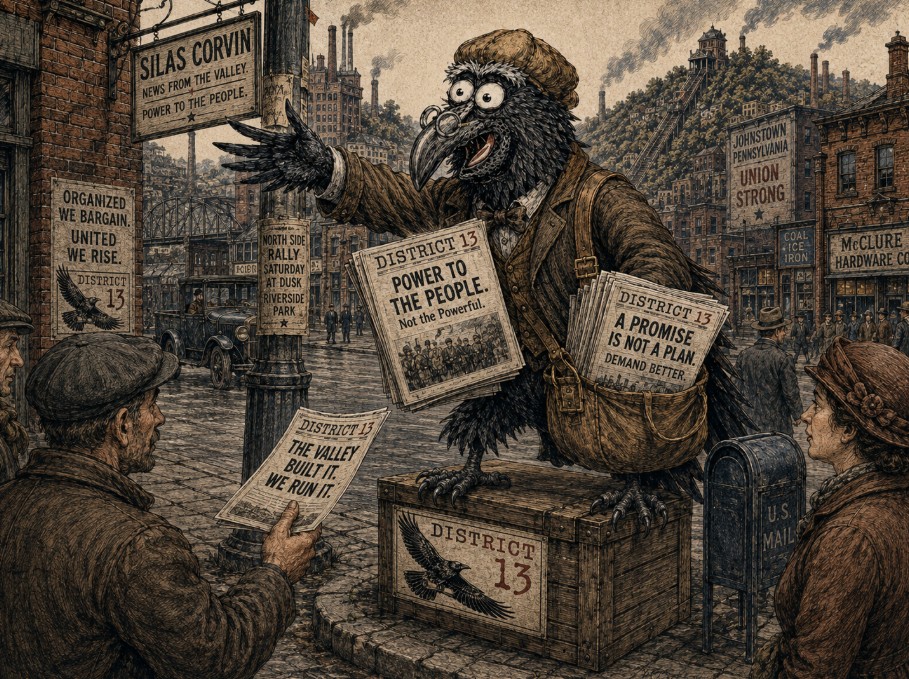
— Silas Corvin, District 13 Raven