A few years ago, after a funeral, I watched three adult siblings stand around a kitchen table and divide what their father had left. There was not much drama. One took the watch, one the fishing rods, one the old cast-iron skillet. The house would be sold, the mortgage paid, and whatever remained divided among them. That is inheritance in the form most of us recognize: not a dynasty, just the last bit of shelter one generation can offer the next.
There is nothing shameful in that. A parent ought to be able to help a child. A couple who spends forty years paying for a house should not have to apologize for wanting it to become a down payment on a grandchild’s future. A farmer should be able to pass a working farm to the daughter who has been on the tractor since she could reach the pedals. A mechanic should be able to leave his shop to the son who already knows where every wrench belongs. Any politics that begins by sneering at those ordinary hopes has already lost the plot.
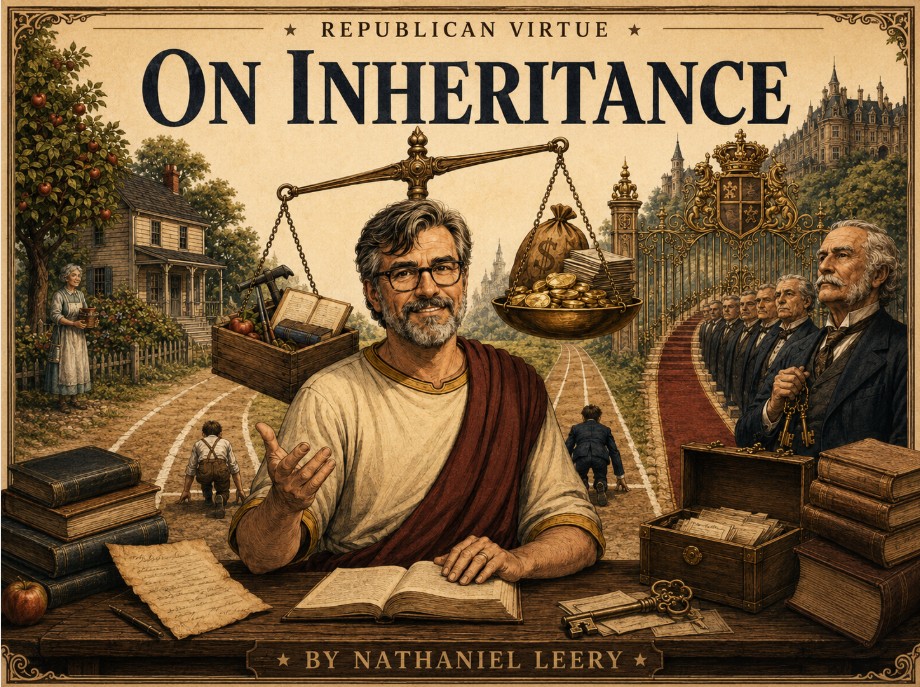
But ordinary inheritance and dynastic inheritance are not the same thing. We pretend they are because the word is the same. A paid-off bungalow and a controlling stake in a national corporation both pass through an estate, but they do not have the same effect on a republic. One gives a family breathing room. The other can give people who never built a thing the power to direct workers, markets, elections, and whole communities for the rest of their lives.
Thomas Jefferson worried about the reach of the dead over the living. In a 1789 letter to James Madison, he wrote that the earth belongs in usufruct to the living. He was speaking mostly about public debt and the power of one generation to bind another, not handing us a ready-made estate-tax schedule. Still, the question is useful. How much authority should yesterday’s success exercise over people who were not alive when it was earned?
American law already gives one answer on the other side of the ledger. When a person dies owing money, the estate must pay valid debts before heirs receive what remains. If the estate has enough, creditors are paid. If it does not, the unpaid balance generally does not become the children’s personal obligation unless they signed for it or some other legal exception applies. The debt stops where the debtor’s estate stops. We do not ordinarily tell a daughter that her father’s failed business must now be carried on her back for the next thirty years.
That is sensible. It would be cruel and economically absurd to make every child inherit every bad decision made before birth. But notice what happens with success. Once the claims are settled, the surplus moves forward. Then it earns. Then those earnings earn. It buys better schools, safer neighborhoods, time for an unpaid internship, access to doctors and lawyers, introductions, collateral, and the ability to survive failure without having one bad year become a permanent sentence. Capital does not merely purchase things. It purchases room to recover.
None of this makes the heir guilty of anything. Children do not choose their parents, rich or poor. A person born into money can be industrious, decent, and useful. A person born without it can be foolish. This is not a sermon about virtue being distributed according to bank balance. It is an argument about the rules under which virtue is asked to compete.
We like to say that capitalism rewards risk. Often it does. But risk does not mean the same thing to everyone. For one young business owner, failure means embarrassment, a stern talk from an investor, and another attempt next year. For another, failure means eviction, ruined credit, lost health insurance, and a decade spent climbing back to the starting point. They may have equal talent. They do not have equal room for error, and markets are much better at recording the final score than explaining how the game began.
This is where the usual debate gets slippery. Mention a stronger estate tax and someone immediately wheels out a family farm, a hardware store, or a widow being driven from her home by an assessor. Those are real concerns. A badly designed tax could do real damage. Productive businesses are not stacks of cash, and farms are often land-rich and cash-poor. A sensible system should allow long payment periods, deferrals, and protections for heirs who keep a genuine family business operating. It should know the difference between keeping a farm in production and inheriting a portfolio large enough to buy the county around it.
That sort of design is not beyond us. We make distinctions throughout the tax code when we care enough to make them. A generous untaxed floor can protect homes, savings, and ordinary family businesses. Rates can rise only on very large transfers. Payment can be delayed when an immediate bill would break up a productive company, then collected if the property is sold or converted into passive wealth. Trusts and shell arrangements created mainly to make ownership disappear on paper can be treated as what they are. None of this requires an appraiser in every garage counting Granddad’s tools.
The argument against any meaningful limit is usually framed as a defense of parental liberty: I earned it, so I should decide where it goes. There is force in that. Property means little if ownership ends whenever the state finds a better use for it. But inheritance is not quite the same as ownership during life. The person making the choice is gone. The recipient did not earn the asset. Society is not taking away the living person’s livelihood; it is setting terms for a transfer that exists because law agrees to recognize wills, trusts, deeds, corporations, and claims after death.
That legal machinery is valuable. It lets families plan, businesses survive their founders, and property move without violence. It is also public machinery. Courts enforce the will. Clerks record the deed. Police defend the title. The currency, roads, schools, workforce, and legal order helped make the fortune possible in the first place. Asking the largest estates to return a share at transfer is not a denial of private property. It is a recognition that no private fortune was built in a vacuum.
There is a conservative reason to care about this too. Concentrated inheritance eventually hardens into caste, even when nobody uses the word. The surnames remain private, but the influence becomes public. Families accumulate not only money but the institutions that protect money: law firms, foundations, media holdings, political access, and the patience to wait out reform. A market economy can survive rich people. It has a harder time surviving a permanent class whose members are rich before they have done anything and insulated after they do badly.
The point is not to flatten every family to the same number. Equal starting conditions are impossible, and efforts to manufacture them too precisely usually become intrusive and foolish. Parents will always pass on habits, education, affection, damage, confidence, religion, recipes, and the names of people who will answer the phone. Government cannot level human life, nor should it try. Money, however, is one inheritance we can see and measure. At the extreme, it is also the inheritance most capable of buying all the others.
I would rather see a republic protect modest inheritance and place firmer limits on dynastic transfer than continue pretending those are the same cause. Let families pass along a home, a farm, a shop, a nest egg, and the small accumulation of a decent life. Let founders provide generously for children and grandchildren. But beyond a high threshold, let some portion return to the country that supplied the peace, law, labor, and infrastructure in which the fortune grew.
What should be done with that revenue is a separate argument, though I would favor things that widen the field rather than enlarge the bureaucracy: lower taxes on work, strong public schools, basic capital accounts for young adults, and infrastructure that makes it easier to build something outside the places where money has already gathered. The purpose is not punishment. It is circulation.
Mina used to say that keeping a thing and tending a thing were not always the same. I suspect she was talking about the pear tree by the barn, but the distinction applies here. Wealth can be preserved so completely that it stops serving the economy that produced it. Capitalism needs accumulation, but it needs turnover too. A forest where nothing ever falls eventually becomes a museum of old trees and very little else.
Inheritance should carry love, memory, and a reasonable measure of security. It should not carry permanent command. The dead may leave us tools. They should not be allowed to decide, generation after generation, who gets to use the whole workshop.