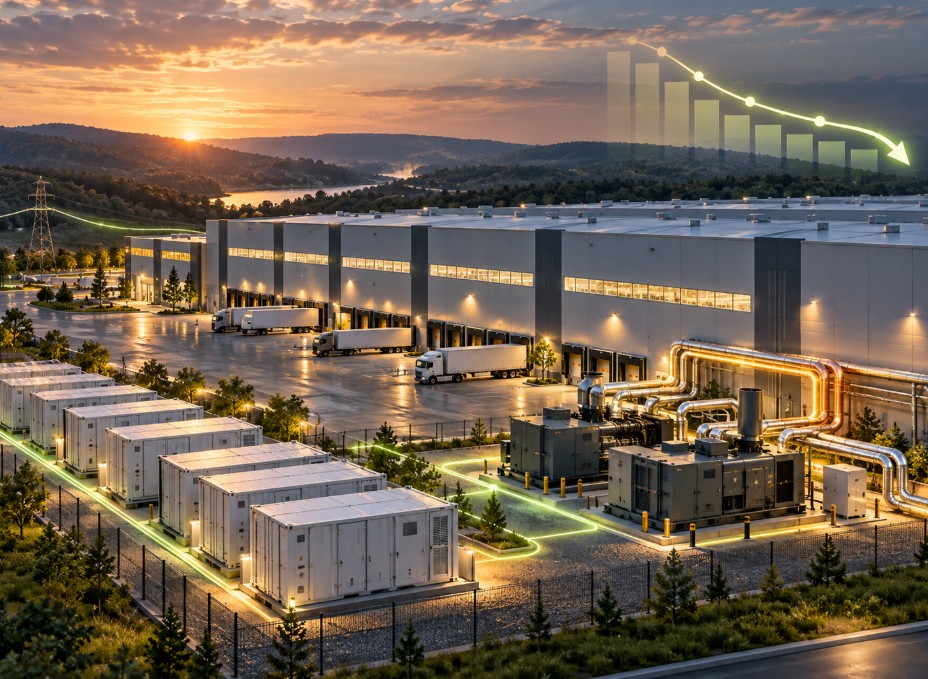
Turning a Warehouse Into Its Own Power Plant
A million-square-foot distribution warehouse in western Pennsylvania pays for electricity in three ways. It pays for the energy it uses, for the highest demand it hits each month, and for a capacity charge set by its draw during five summer hours. That last charge has climbed fast. PJM, the regional grid operator, has cleared its capacity auction at the price cap three years running. The 2028/2029 auction settled at $325 per megawatt-day, and PJM estimates it would have reached $554.72 without the cap. For a warehouse drawing 2 MW during those five hours, the capacity charge alone runs close to a quarter million dollars a year.
The plant described here goes after that bill with an engine, a battery, and a couple of pumps.
The building
The model building is a typical non-refrigerated distribution center. LED high-bay lighting draws about 450 kW. A fleet of around 80 electric forklifts charges between shifts. There are 20,000 square feet of offices, plus fans and dock equipment. Summer peak lands near 2 MW, and annual use near 8 million kWh. Heat comes from gas unit heaters and makeup-air units, and Johnstown winters ask a lot of them. At this size, recovered heat supplements the heating system without replacing it.
The equipment
Two 400 kW dual-fuel engine-generators run on pipeline natural gas, using a small diesel pilot injection to light the charge. Engines built for high substitution run 85 to 90 percent gas at steady load. Diesel is the escape hatch. When gas prices spike or supply gets curtailed, the engines carry the full load on liquid fuel from a 10,000-gallon tank, about a week of full-output running. The liquid side takes petroleum diesel, renewable diesel, or biodiesel blends, so purchasing can follow whichever fuel is cheapest. As biodiesel production develops toward cheap, abundant supply, the plant moves in stages from B20 toward running on biodiesel exclusively. Fuel storage is heated from the engines’ own heat loop, which keeps biodiesel flowing through the winter.
A 1.5 MW, 4.5 MWh sodium-ion battery sits in passively cooled containers along the yard edge. Lithium battery fires have made insurance carriers wary of large installations. The January 2025 Moss Landing fire in California burned for days, and that image comes into the underwriting meeting. Sodium-ion cells are far less prone to thermal runaway, and they can be shipped and stored fully discharged. They hold capacity well in the cold, and the sodium comes from domestic soda ash. American-made systems begin shipping in 2027. The trade-off is size: sodium-ion stores less energy per cubic foot than lithium, and a warehouse site has the room.
Variable-speed pumps move engine coolant and exhaust heat through a plate exchanger into a hydronic loop. In order, the loop feeds:
- makeup-air preheat coils
- radiant slab tubing or hydronic unit heaters
- snow-melt loops at the dock aprons
- a thermal store that carries the morning warm-up when dock doors open
- a summer dump radiator for surplus heat
How it runs
In winter, both engines run near continuously because the heat has a use. Year-round, the battery charges overnight, forklift charging moves off-peak, and the battery trims the afternoon peak that sets the monthly demand charge. On summer days when a grid peak looks likely, both engines run full, the battery discharges, forklift charging pauses, and low-traffic lighting dims. Grid draw during those hours falls from about 2 MW to around 0.2 MW. That cuts the building’s capacity charge for the following year.
What it earns
| Stream | Annual |
|---|---|
| Capacity charge cut (1.8 MW at $325/MW-day) | ~$214,000 |
| Monthly demand charge (1 MW shaved) | ~$96,000 |
| Engine power and heat, net of fuel at 90% gas | ~$63,000 |
| Total | ~$373,000 |
What it costs
| Item | Installed |
|---|---|
| Dual-fuel engine plant | $2.2–3.0M |
| Sodium-ion battery, after the 30% storage tax credit | $1.1–1.4M |
| Heat recovery, pumps, thermal and fuel storage, controls | $0.7–1.1M |
Simple payback on the full plant runs 11 to 15 years at today’s capped capacity price. Split apart, the picture sharpens. The battery and load controls earn about $215,000 a year on roughly $1.2 million, a five-to-seven-year payback. The engines earn about $158,000 a year in power, heat, and peak-hour capacity. Their larger value is harder to put in a spreadsheet: a building that keeps working through outages and can’t be cornered by a single fuel market. If capacity prices come off the cap toward PJM’s uncapped estimate, the full plant’s payback drops to eight to ten years.
Before it goes in the ground
Four checks shape the final numbers:
- Utility efficiency incentives under Pennsylvania’s Act 129 can hand the capacity rights for the demand reduction to the utility.
- The same megawatt usually can’t earn both a lower capacity charge and a demand response payment.
- Stationary diesel engines worked for peak shaving need Tier 4 emissions controls.
- Penelec’s actual demand and transmission rates belong in the model before any client sees a figure.
Sources
- PJM, 2028/2029 Base Residual Auction results: https://www.pjm.com/-/media/DotCom/about-pjm/newsroom/2026-releases/20260714-pjm-capacity-auction-procures-138318-mw-of-generation-resources.pdf
- New Project Media, PJM auction uncapped price estimate: https://newprojectmedia.com/?p=19896
- mgrid, PJM capacity charges and peak load contribution: https://mgrid.org/2024/07/26/pjm-capacity-price-surge-forces-industrial-demand-charge-management/
- FirstEnergy Pennsylvania, Act 129 program overview: https://pages.willdan.com/hubfs/FE%20PA%20FirstEnergy/FE%20PA_Program%20Overview_flyer_v8.pdf
- Energy-Storage.news, storage tax credit after the 2025 budget bill: https://www.energy-storage.news/us-energy-storage-to-retain-momentum-post-reconciliation-bill-near-term-rush-to-complete-projects/
- Interesting Engineering, Peak Energy sodium-ion plant: https://interestingengineering.com/energy/us-sodium-plant-to-power-million-homes
- pv magazine, sodium-ion density and cost: https://www.pv-magazine-india.com/?p=7237
- EIA, Pennsylvania commercial natural gas prices: https://www.eia.gov/dnav/ng/hist/n3020pa3A.htm