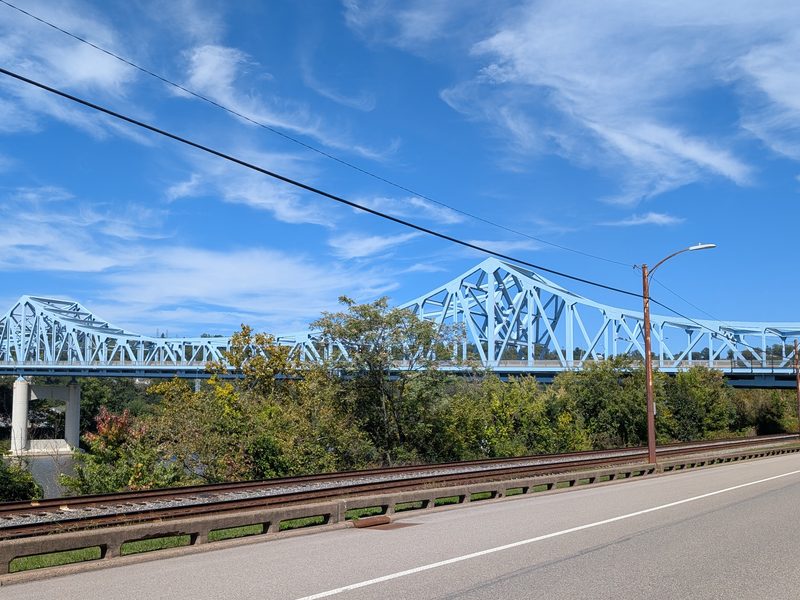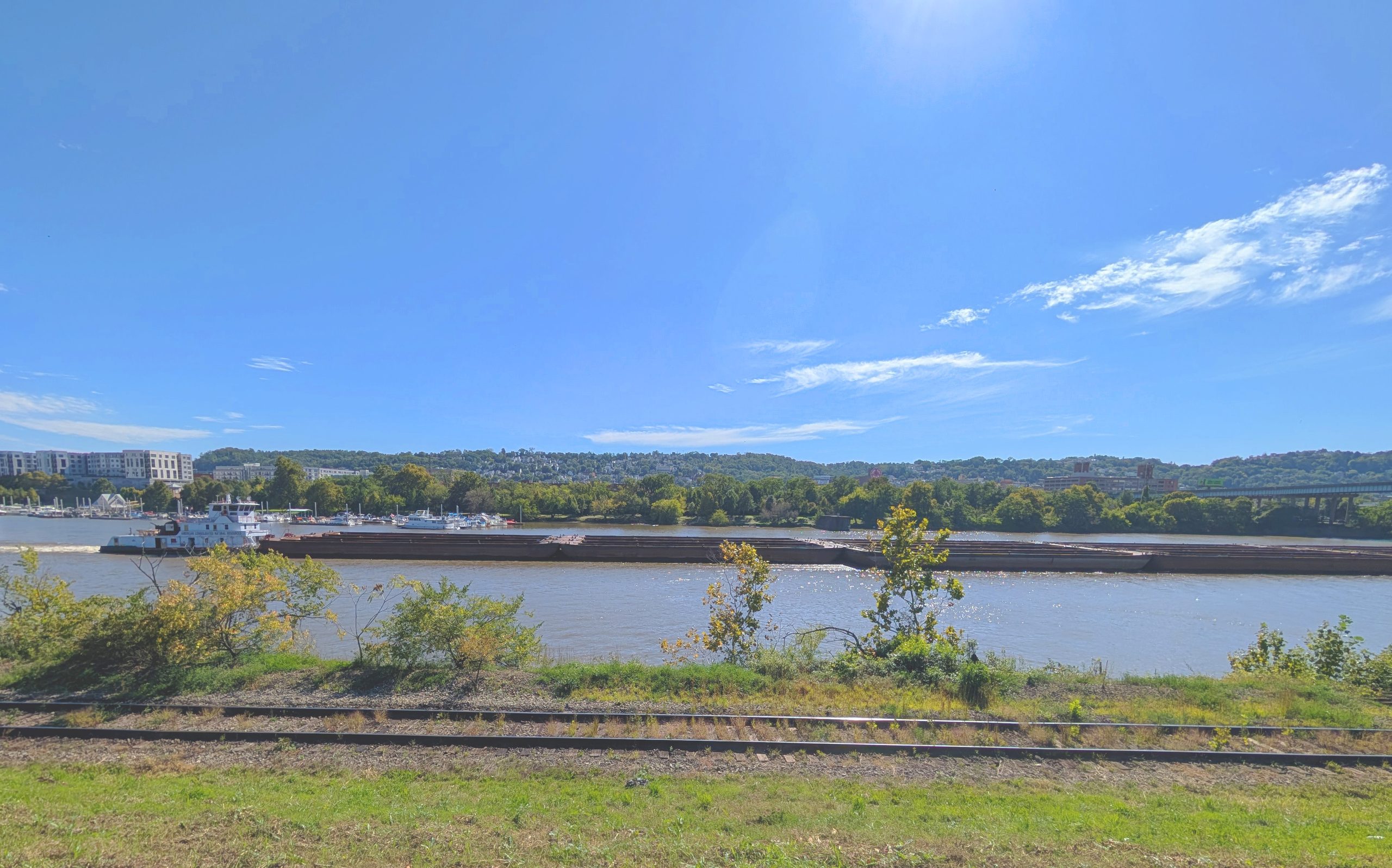
Stand on the bank here and you can see three generations of American freight in one frame. A pair of rails runs through the weeds at your feet. A highway bridge crosses the far end of the view on concrete piers. And out on the river, a white towboat is shoving a long string of rust-brown barges upstream at about the speed of a brisk walk.
Landlubbers call that boat a tug. River people will correct you. A tug pulls, or nudges big ships around a harbor. A towboat pushes, and it’s built for it: flat bottom, square bow, and a pair of tall steel uprights on the front called push knees that press against the back of the barges like a man leaning his shoulder into a stalled car. The barges get lashed together with steel cable into a single rigid raft, and the whole assembly, boat and barges together, is called a tow. Strange name for a thing that never pulls anything.
The lettering on this boat’s cabin reads American Consolidated Natural Resources, the Ohio coal outfit that came out of Murray Energy’s bankruptcy. The barges are open hoppers riding high in the water, sides well above the waterline, which tells you they’re empty. Odds are they’re headed upstream to fill up and ride back down low and heavy, decks a few feet off the river, carrying the stuff these rivers were dredged and dammed to carry.
The numbers on a barge sound made up. A standard dry-cargo barge holds around 1,750 tons. A rail hopper car holds about 110, a semi about 25. Line up a big fifteen-barge tow and you’ve got the load of 216 rail cars or roughly 1,050 trucks, pushed by one boat with a crew you could seat around a kitchen table.
Fuel tells the same story. A Texas A&M Transportation Institute study found a barge moves one ton of cargo about 647 miles on a gallon of fuel. Rail gets about 477. A truck gets about 145. Water does most of the lifting, the way it does when you float a heavy box across a pool instead of carrying it across the deck.
The catch is speed and geography. A barge goes where the river goes, at the river’s pace, and the rivers around Pittsburgh only work as highways because of locks and dams that turn them into a staircase of flat pools. Every lock is a chamber the tow has to squeeze into, sometimes in pieces, wait while the water rises, then push out the other side. A trip that takes a trucker an afternoon can take a towboat days. For coal, gravel, grain and steel, nobody’s in a hurry, so the trade works fine.
Across the water, a marina full of white pleasure boats sits tied up along the far bank, apartments stacked on the hill behind them. It’s a good snapshot of what Pittsburgh’s rivers carry now. Folks with weekend cruisers share the channel with working boats that have to sound the horn and hope the cabin cruiser gets out of the way, because a loaded tow needs a long stretch of river to stop. Picture a freight train on ice skates.
The rails at the bottom of the photo look like they don’t see much traffic anymore, weeds poking up between the ties. The highway bridge carries the cars. And the river, which moved freight through this valley long before either of them, is still out there doing it, one slow push at a time.
Sources:
- Texas A&M Transportation Institute, Center for Ports and Waterways, “A Modal Comparison of Domestic Freight Transportation Effects on the General Public: 2001–2014” (January 2017), as reported by Marine Log and The Maritime Executive
- Waterways Council, barge capacity comparisons (Texas Transportation Institute data)
- Ingram Barge Company, sustainability overview (cargo capacity per mode)