A Bright Meadow Group thought experiment in possibilities for unanswered questions
The Great Pyramid holds about 2.3 million blocks, averaging around two and a half tons apiece. We know a fair amount about how they got there. Barges brought stone down the Nile and up a branch channel that once ran to the foot of the Giza plateau. Sledges carried blocks overland. A tomb painting of Djehutihotep shows a man standing on the front of a sledge, pouring water on the sand ahead of a colossal statue, and physicists in Amsterdam showed in 2014 that the right amount of water cuts the pulling force on desert sand roughly in half. Excavators have found thin layers of tafla clay under blocks abandoned mid-move, a clay that turns slick when wet.
So the Egyptians understood that the surface under a load decides how many hands it takes to move it. This piece asks what the next rung on that ladder might have looked like. What if they had ice?
Observe
The Forbidden City. In Ming dynasty Beijing, builders needed to move stones far too heavy for wheels. A written account from 1557 describes a stone of roughly 123 tons dragged about 70 kilometers over 28 days. The crews dug wells along the route at intervals of about half a kilometer, poured water onto the frozen road, and slid the stone on a sledge across the glaze. A 2013 study by researchers at Princeton and in Beijing worked through the physics and found that a thin film of water on top of the ice made the sledge slide easier than dry ice would. By their count, dragging that stone over dry ground would have taken about 1,500 men, bare ice about 340, and water-glazed ice 46. A dug well, a bucket and a cold night turned a road into a slide.
The yakhchal. Beijing has real winters. Egypt is a harder case, so the better proof of concept comes from Persia, where desert people made ice with mud brick and patience more than two thousand years ago. On winter nights they ran water from a qanat into long, shallow pools shaded on the south side by a tall wall. Under a clear, dry desert sky, the water radiated its heat straight up into space and froze, even on nights when the air stayed above freezing. Before dawn, workers cut the ice and carried it into the yakhchal, a beehive dome over a deep pit, built with thick walls of sarooj, a mortar of sand, clay, lime, ash and goat hair. Some sites paired the dome with windcatchers, the badgir, to pull cool air through. The ice lasted into summer.
That system needs still water in shallow pans, shade from the low winter sun, and a clear dry sky. The Egyptian desert edge has plenty of the last one. Cold enough nights are the open question.
Evaporation. Dry air offers a second source of cold. Egyptians already cooled drinking water in porous clay jars that sweat through their walls, the same principle as the zeer pot still used across the region. As water evaporates, it pulls heat out of what’s left behind, dragging its temperature down toward what meteorologists call the wet-bulb temperature. In humid air that number sits close to the air temperature. In dry desert air the gap is wide. On a winter night around 8°C with low humidity, wet-bulb can land only a couple of degrees above freezing. Stack radiation to the night sky on top of evaporation, and water can freeze on nights a plain pan would miss. The old ice pits of northern India worked this way: shallow porous dishes set on straw, evaporating and radiating at once.
The Egyptian toolkit. The pyramid builders had canals, clay, porous pottery, mud brick, domed granaries, and a workforce organized into gangs with names and rations. The yakhchal and the badgir ask for no tool they lacked.
Design
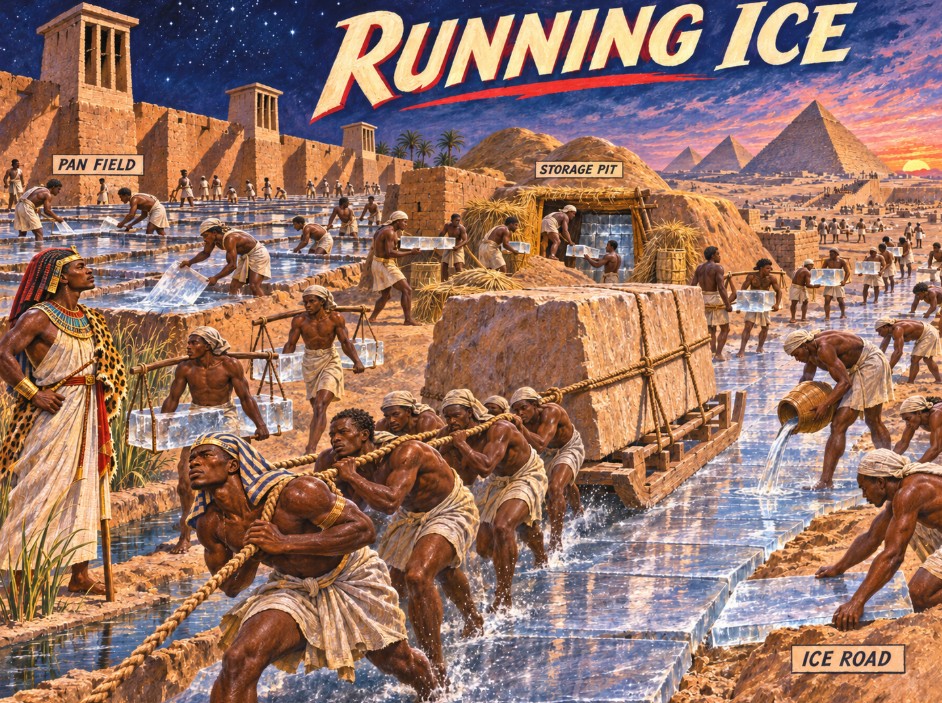
Picture the ice fields first. Along the desert margin near the quarries and causeways, rows of shallow pans of unglazed clay, a hand deep, sit behind long mud-brick shade walls. At dusk, crews fill them from channels off the Nile branch.
Windcatcher towers stand along the rows. Here the design has to strike a balance. Moving dry air drives evaporation, which cools the water. Moving air also hands heat back to the water once the water drops below the air temperature, which is part of why the Persians built tall walls around still pools. So the towers draw air in from above and feed it down through channels under or between the pans, so the porous clay sweats from below while the surface stays sheltered and open to the sky. The shade walls double as wind baffles. The builder tunes the system like a damper on a woodstove, opening for evaporation, closing to hold the cold.
On a good night, each pan grows a skin of ice. Before first light, workers break it into slabs, stack it into straw-packed pits under domed roofs, and build up a store through the coldest weeks. The towers serve the pits too, pulling dry air through the stacks the way the Persian domes kept their ice into summer.
Then the road. The roadbed is cut in three strips: two shallow lanes for the sledge runners, with raised walkways beside them, crowned so water sheds off the walkways and into the lanes. A sledge sits loaded at the quarry before dawn, resting on a timber cradle over damp clay where its runners have nothing to freeze to. When the haulers take up the ropes, ice gangs carry slabs on shoulder yokes and set them down in the lanes like pavers, a splash of water glazing each one. The haulers lean in and the sledge slides off the cradle onto the ice. Behind it, another gang lifts whatever slabs survived the pass and runs them forward past the sledge to lay down again, the way a man crossing mud lays a plank ahead of himself and picks up the one behind. The slab carriers have to stay ahead of the stone, and the stone has to stay ahead of the sun.
The haulers never set foot on the ice. They work the raised paths on either side, on clay scattered with straw from the ice pits, in sandals with soles of knotted cord that bite into mud like tread on a tire, or barefoot, toes spread and sunk in the way a field hand’s go into a wet furrow.
Once the stone moves, it keeps moving. The Beijing numbers put water-glazed ice at about a thirtieth the friction of dry ground, and wet sand at its best runs about half of dry. On wet sand, a sledge at walking pace stops within a stride of the ropes going slack. On wet ice it slides on for two or three meters, and the weight of the block has no say in that distance. By the Beijing study’s own arithmetic, a couple of men could keep a two-and-a-half-ton block gliding on glazed ice. The crew earns its rations on the first heave, on the grades and at the brakes.
The meltwater left behind does its own job. It runs into the lanes and soaks the tafla and sand for the next sledge, so the wet-sand method and the ice method feed each other. When the sledge runs off the last paver, it lands on slick clay and slows over a distance, then onto wet sand and slows a little more. One heave carries the block across three surfaces in a row, and the slides add up. The water can also overshoot. Clay soaked past its best turns to mud, and the runners sink and shove a bow wave ahead of them. A single slab half a meter by a meter and three centimeters thick melts to about fifteen liters. The gang lifting spent pavers is also the gang managing the water, and pulling a slab before it finishes melting may matter as much as reusing it. Wide sledge runners spread the block’s weight across ice and clay the way a snowshoe spreads a man’s weight across snow.
Low friction cuts both ways on a grade. On wet ice, a slope steeper than about one in fifty lets the block slide on its own. Downhill legs would need brake crews with snubbing ropes wrapped around posts, paying out line. Uphill, even a slight grade adds as much drag as the friction does, so the slope sets the size of the crew more than the surface does.
The window is short: a few hours between the coldest part of the night and the morning sun, in the coldest months of the year. Ice would make sense as a special-purpose tool for the heaviest pieces, the granite beams over the King’s Chamber, the largest casing stones, the long hauls where friction runs up the bill.
Intervene
A thought experiment earns its keep when it points at a shovel. This one points at four.
Build a pan field at Giza. One winter, three rows of unglazed clay pans behind a mud-brick shade wall: one row open to the sky alone, one fed by a windcatcher from below, one exposed to direct airflow across the surface. Thermometers and humidity gauges in the air and in the water. Count the nights each row produces ice and measure its thickness. This test can end the idea in one season or hand it a foundation, and it will show whether the tower earns its place.
Run a sledge trial. A replica sledge with a two-and-a-half-ton block, pulled over ice pavers, wet clay, wet sand, and dry sand. Count the haulers each surface needs to start the sledge and to keep it moving. Then let the ropes go slack at walking pace and measure how far it slides on each. Run the clay at several moisture levels to find where it stops helping and starts swallowing the runners.
Survey for the factory. Ice leaves no residue, but the plant that makes it does. Long east-west walls, shallow plastered or clay basins in rows, tower footings, air channels, insulated pits near the quarries and causeways, and roadbeds with sunken lanes flanked by raised walkways. Archaeologists know what a yakhchal looks like in Iran. Someone should look for its cousin in Egypt.
Reread the record. Scan the tomb paintings, the Wadi al-Jarf papyri and the workers’ village records for frost, cold storage, towers, or night work at basins.
The pyramid builders already proved they treated water as a tool and the desert air as a resource. If the sky and the dry wind gave them ice on enough nights, they had the people, the clay and the organization to run it. Whether they did is a question for a thermometer and a trowel.
Sources
Fall et al., “Sliding Friction on Wet and Dry Sand,” Physical Review Letters, 2014
Li et al., “Ice lubrication for moving heavy stones to the Forbidden City in 15th- and 16th-century China,” Proceedings of the National Academy of Sciences, 2013
Christian Science Monitor, “Ancient Egyptians used wet sand to drag massive pyramid stones, say scientists,” May 2, 2014
Physics World, coverage of the wet-sand sledge experiment, 2014
Sheisha et al., on the Khufu branch of the Nile, 2022/2024