Observe → Design → Intervene
Japan has been our second-largest audience by pageviews for most of a year. Not a spike, not a single post going around — steady traffic, month over month, into the River Refugium Project archive and the aquaponics material underneath it. When a country reads your work that consistently, the professional response is to go find out what they already know.
So we did. What follows is the observation phase, written up honestly, including the part where our expectations were wrong in a direction we did not anticipate.
What we expected
Japan has a cultural relationship with cycles that is not a marketing position. Rice paddies as engineered wetlands. Fish and rice in the same water for centuries. A concept — satoumi — that holds a coastal sea is more productive with human management than without it, which is a sentence that took Western conservation another forty years to be willing to say out loud. Add to that a manufacturing base that solves problems by miniaturizing and optimizing them until they disappear.
Going in, the working assumption was that we would find something well past our own design horizon. Municipal-scale nutrient harvest. Sewage-fed protein at industrial volume. Something operating at a level that would make the RRP look like a sketch.
That is not what is there.
What is there
Start with what they accomplished, because it is genuinely extraordinary and the rest of this makes no sense without it.
The Seto Inland Sea in the early 1970s was called the dying sea. Red tides peaked at 299 recorded occurrences in 1976. The 1973 Seto Inland Sea Law and the Total Pollutant Load Control System that followed put every discharger over 50 cubic meters a day under load caps for organic carbon, then nitrogen, then phosphorus. Fifty years later, red tide occurrences were down to 59. Land-based nitrogen loading fell roughly 40 percent. Phosphorus fell roughly 60 percent.
Sixty percent. On phosphorus. Across a watershed holding thirty million people.
For anyone who has read The River Is the Supply Chain or watched Gulf hypoxia refuse to move for two decades, that number should stop you where you stand. It is the largest sustained nutrient reduction in the industrialized world and nobody in American water policy talks about it.
Then it kept going.
Seto fish catch fell to about a third of its 1980s peak. Cultivated nori started losing color — the pigment failure that means the plant is nitrogen-starved. Fisheries cooperatives began arguing that the water had been stripped past the point of productivity, and researchers put a name to it: cultural oligotrophication. Human-caused nutrient poverty.
We do not have an opinion on that causal claim and are not going to pretend otherwise. The literature is genuinely split. Kuninao Tada and colleagues at Kagawa University published a review finding that while land loading dropped 40 and 60 percent, seawater concentrations did not fall correspondingly — legacy organic matter in the sediment keeps releasing phosphorus decades after the pipes were fixed. Water temperature is up. Seagrass beds and tidal flats are down about ninety percent in some bays. The Fisheries Research and Education Agency puts warming first among causes of nori decline. Anyone claiming a clean single-variable answer is selling something.
What is not disputed is what Japan did about it. In June 2021 the Diet amended the Seto Inland Sea Law to create a nutrient management system permitting prefectural governors to plan for increases in nitrogen and phosphorus in designated waters. Hyogo filed first, October 2022, naming 28 sewage treatment plants as nutrient supply implementers. Yamaguchi’s plan for the Ube nori grounds sets a floor of 0.2 mg/L total nitrogen and a ceiling of 0.6, with a mandatory stop order if anything goes wrong.
And this past May 7, the Central Environment Council delivered its answer on the tenth round of national load control. Its title, translated: Transition from Total Load Reduction to Total Load Management. Under the old system, targets could hold or fall. Under the new one, they can rise. Tokyo Bay, Ise Bay, Seto Inland Sea — all three.
A country that spent fifty years and enormous political capital removing nutrients from water has written the legal authority to put some of it back. Whatever you think of the science, that is institutional courage of a kind we do not have.
And then we looked at the machinery
Here is where it got strange for us.
We wanted to know what the removal technology was. The assumption was filtration, chemistry, membranes — engineered separation at scale.
It is bacteria. It is almost entirely bacteria.
Japanese advanced treatment — kōdo shori — runs sewage through a redox sequence. Anaerobic tank, anoxic tank, aerobic tank. In the aerobic zone, nitrifying organisms convert ammonia to nitrate. Recirculation carries that nitrate back to the anoxic zone, where denitrifiers reduce it. In the anaerobic zone, phosphorus-accumulating organisms release phosphate and take up organic carbon; in the aerobic zone they take up more phosphorus than they released, and the phosphorus leaves the plant locked in the wasted sludge.
Read Lessons from the Aquarium — The Nitrogen Cycle and then read a Yokohama municipal explainer of A2O treatment. They are describing the same organisms doing the same work. The difference is tank volume and a control system.
Japan built the biological half of the River Refugium Project at municipal scale, in concrete, across roughly two thousand plants, and has been running it for forty years.
They just do not harvest it.
The nitrogen leaves as nitrogen gas. Denitrification reduces nitrate to N₂ and vents it to atmosphere. That nitrogen was fixed out of the air by Haber-Bosch at something like one to two percent of world energy consumption, shipped across an ocean, applied to a field or fed to an animal, eaten, excreted, and then Japan spends more energy — aeration, plus a carbon source for the denitrifiers — to convert it back into the inert gas it started as. You pay to fix it. You pay again to unfix it. And incomplete denitrification leaks nitrous oxide on the way, which carries roughly 273 times the warming punch of carbon dioxide.
The part that will not sit still
Given how our own designs are built — The Refugium, Appendix E’s feed pathway, the whole argument in The Loop That Feeds You — watching a functioning biological nutrient capture system terminate in atmospheric release is disorienting. Then we looked at the import ledger and it got worse.
FAOSTAT put Japan’s fertilizer nitrogen application at about 369,000 tonnes on an N basis, on roughly 4.4 million hectares of cropland. Japan imports 1.6 to 1.8 million tonnes of chemical fertilizer product a year. Urea self-sufficiency is around three percent. In the most recent fertilizer year, 74 percent of urea came from Malaysia, 72 percent of phosphate ammonium from China, 78 percent of potassium chloride from Canada.
Japan was not always on that side of the trade. At its peak it exported over two million tonnes of urea and stood third in the world in nitrogen fertilizer exports, running on domestic ammonia and co-product ammonium sulfate. The oil shocks broke the feedstock economics, plants closed through the eighties, and by the nineties the country had switched to buying finished product. They did not lose the capability. They offshored it on energy price, and then in 2021 the price came back.
The nitrogen picture is worse than the fertilizer number suggests, and this is the observation we would most want checked by someone with the mass-balance data. Japan imports far more nitrogen embedded in soybeans, corn, wheat, and fishmeal than it does in fertilizer bags. That nitrogen never touches a Japanese field. It goes through Japanese people and Japanese livestock and arrives at a treatment plant. Which means a substantial fraction of what those aeration basins are venting is imported food nitrogen making one pass through the country before being destroyed at additional energy cost. Kentaro Hayashi’s Japanese nitrogen budget work is where that number lives, and it fed directly into Japan’s National Action Plan on Sustainable Nitrogen Management in September 2024.
Phosphorus tells the same story with the opposite ending. Roughly 2.3 million tonnes of sewage sludge annually, containing about 50,000 tonnes of phosphorus. MAFF’s own comparison: domestic sludge holds phosphate equivalent to 12 to 16 percent of Japan’s imported phosphorus. Current fertilizer utilization of that sludge sits near 15 percent, and dedicated phosphorus recovery runs at five municipalities across six treatment plants. The Cabinet set a target in December 2022 to reach 40 percent domestic phosphorus by 2030.
Phosphorus got the national target because you cannot manufacture phosphorus. Nitrogen did not, because you can. That is the whole logic, and it is defensible right up until you count the energy twice.
Appendix I makes the mirror-image argument on our side of the water: recirculating aquaponic systems run chronically phosphorus-limited and buy mined rock phosphate to correct it, while river water has too much. We wrote that river systems run that cycle in the correct direction. Japan’s sludge stream is the same argument at fifty thousand tonnes a year.
Why we would still bet on them
Everything above reads as criticism. It should not.
Here is what a country that vents its nitrogen also has. It has NEDO Moonshot Goal 4, with Toru Kawamoto at AIST managing a nitrogen program whose stated benchmark is recovering nitrogen from exhaust gas and wastewater at lower CO₂ and lower cost than both existing wastewater treatment and existing ammonia manufacture. They are attacking the concentration problem with forward osmosis, membrane distillation, zeolite membranes, and engineered ammonia adsorbents. They named the planetary boundary in the project rationale.
It has a nutrient management regime that can be dialed seasonally without building anything, because turning denitrification down means shortening solids retention time and cutting the coagulant dose. A reversible national-scale nutrient valve, achieved through operating procedure.
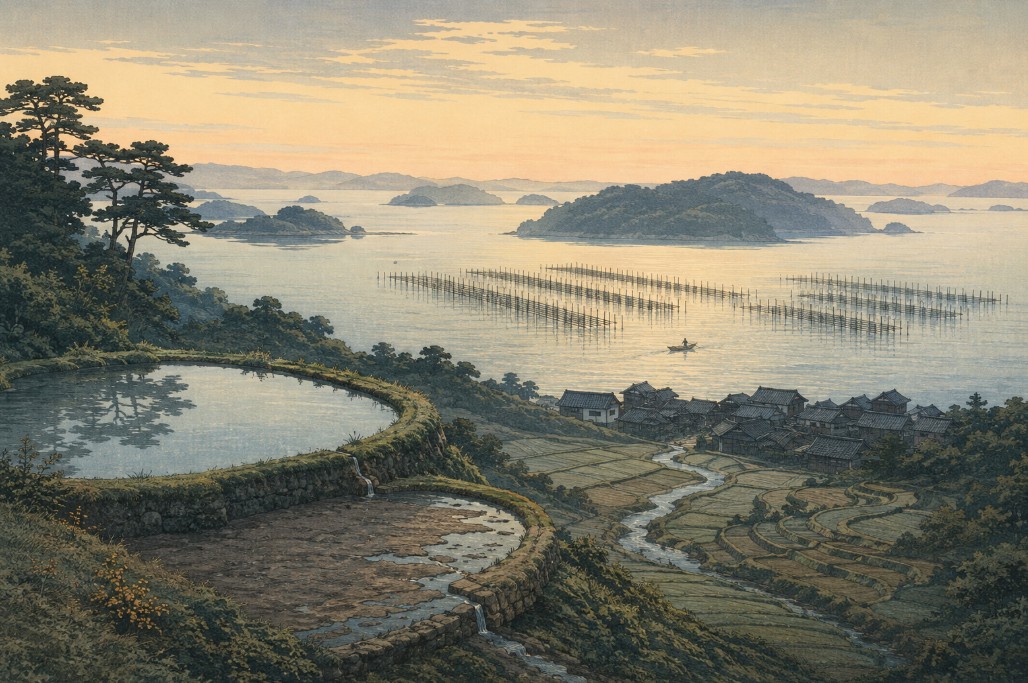
It has kaibori — Hyogo farmers draining irrigation ponds in the agricultural off-season so nutrient-rich sediment washes downstream to feed the nori beds, with the dewatered mud returned to fields as topsoil, and the prefecture coordinating the timing between farmers and fishermen. That is a closed loop run by agreement between two industries, at municipal scale, using a hoe and a calendar. It has been happening since at least the Edo period and we had never heard of it.
It also carries a design risk nobody seems to be tracking. Traditional kaibori runs on a multi-year interval set by what the embankment needs — Hyogo’s own extension guidance says once every several years, and the ponds the prefecture actually worries about are the ones that have gone decades without opening the bottom sluice at all, silting up until storage capacity and emergency release are both compromised. Cost enforces the same rhythm; a full drawdown and desilt runs into the millions of yen. The disturbance is periodic by design, and the conservation ecologists who now run kaibori for biodiversity rather than agriculture argue that the periodicity is precisely what sustains the pond community.
But the nori beds need nitrogen in January. Every January. And warming is making that worse. When the fisheries clock starts setting the maintenance schedule instead of the embankment clock, the interval compresses, and the ponds selected get selected for downstream position rather than maintenance need. Bacteria recolonize from the inflow in weeks — a tame-ike has a watershed, groundwater, a seed bank in the exposed margin, and a residual sediment layer, so the microbial argument against drawdown does not hold the way it would in a closed tank. The organic carbon those organisms run on is the part that does not come back on that schedule. It accumulates from years of settled production, it is what drives denitrification and feeds the benthic community, and we could find nobody measuring it across successive cycles on the same pond. That is a cheap study and somebody should do it before the interval tightens.
It has fishing cooperatives towing harrows across the seabed and spreading chicken manure on the water because the government would not move fast enough for them. It has Fukuoka running MAP struvite recovery and putting the product into a commercial fertilizer line. It has Kobelco demonstrating hydrothermal carbonization of sewage sludge at pilot scale, hitting JIS fuel spec and fertilizer standard from the same process, and getting it certified as a new technology in March 2025.
And in November it hosts the 10th International Nitrogen Conference in Kyoto, chaired by Hayashi, the first one ever held in Japan, with a Kyoto Declaration as the intended output.
If we had money to bet — and to be clear about the state of the balance sheet, we do not — it would go on Japan closing these loops before anyone else in the industrialized world. Not because they are further along than we assumed. They are behind where we assumed on the harvest side. But they have the biological infrastructure already built and paid for, a legal framework that already permits nutrient management in both directions, a fertilizer import position that makes the economics urgent, and a research establishment that has already written down the correct target.
The gap between what Japan has and what Japan needs is one step: stop venting and start harvesting. That is a smaller step than the one they already took.
The open hand
We would like to be part of that. We have no illusions about the shape it would take — the RRP is a framework published by one person in western Pennsylvania with a janitor’s schedule and a home lab, and Japan has institutions with more capacity in a single prefectural fisheries station than we will ever have. The contribution is not capacity.
What we have is a framework built from the start around the thing Japan skips: biological capture terminating in a harvested product rather than a vented gas. The five appendices that closed Version 2 are all downstream questions — what do you do with the biomass once you have it. Feed. Coppice. Fiber. Sequestration. Compost. Every one of them is an answer to a question Japanese wastewater treatment does not currently ask.
The same terms apply that always have. No patents, no proprietary claims, no gatekeeping. If a Japanese prefecture, university, cooperative, or engineering firm can build this faster or cleaner than we can, take it. If someone reading this in Japanese has correction to offer — and there will be corrections, because this was assembled from ministry documents, prefectural PDFs, and journal abstracts by an American reading translations — the forum is open and the email is at the bottom.
Wrong in which direction matters enormously. It always has.
Sources and caveats
Built from Ministry of the Environment and MLIT documents, prefectural nutrient management and pond conservation materials (Hyogo, Kagawa, Yamaguchi), Fisheries Agency program reports, MAFF fertilizer statistics, FAOSTAT, and peer-reviewed work including Tada et al. (2023) on Seto nutrient and fisheries trends and Yamamoto (2003) on cultural oligotrophication. The virtual nitrogen import figure is described structurally and not quantified here because we do not have a verified number; Hayashi’s national nitrogen budget is the source to pull. Prefectural nutrient management plan adoption may extend beyond the three confirmed here. Corrections welcome and wanted.
Where the rest of it is
The RRP archive: cernunnosfoundation.com/rrp
The Version 2 close and its five appendices
- River Refugium Project — Five New Appendices, and the Close of Version 2
- Appendix E — Agricultural Feed Production Pathway
- Appendix F — Coppice Pole and Rod Production
- Appendix G — Fiber Production Pathway
- Appendix H — Metal and Micropollutant Sequestration Pathway
- Appendix I — Compost Production and Integrated Poultry
Previous releases
- River Refugium Project V2 Update — April 2026
- Version 2.0 Release & Development Update
- The River Is the Supply Chain — Operator Brief introduction
- RRP Early Feedback Q&A — twelve hard questions, answered without hedging
Field testing
- Prove the Fix — the invitation, and the Field Documentation Kit
- Lake Erie’s Green Slick — Rust Belt deployment
- Your Neighborhood Pond Is GROSS! — HOA and municipal scale
- Low Nutrient Polluted Water Solution — acid mine drainage, and the direct ancestor of Appendix H
Aquaponics, food, and the systems underneath all of it
- The Loop That Feeds You
- The Refugium — the part most systems get wrong
- Currents in Aquaponics
- Fish Farming Solutions
- Expanding the Margins of Pond Production
- Aquaculture Musings
- Real Farm to Restaurant
- The Third Ethic — why permaculture requires technology
- Lessons from the Aquarium — The Nitrogen Cycle
- “Just” Aquaponics and Reconsidering Aquaponics
- We Can Fix This — So Let’s Get In It
Argue with it: r/Cernunnos_Foundation — why the forum exists
Robert Smith
robert@brightmeadowgroup.com